

























While the political observers view the induction of former IAS officer Sujata Rout, as an attempt to revive the influence of former bureaucrat V. Karthikeyan Pandian through his wife, BJD leaders and workers see it as the arrival of a capable administrator who can reconnect the party with the people, particularly women and the youth.
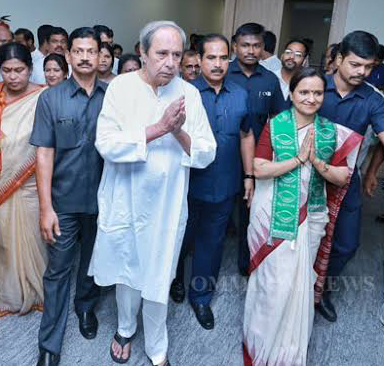
The induction of former IAS officer Sujata Rout Kartikeyan into the Biju Janata Dal (BJD) has once again brought Odisha’s political landscape into sharp focus. Her formal entry into the regional party at Shankha Bhavan in the presence of BJD president Naveen Patnaik has triggered intense political debate in the state. While the opposition views it as an attempt to revive the influence of former bureaucrat V. Karthikeyan Pandian through his wife, BJD leaders and workers see it as the arrival of a capable administrator who can reconnect the party with the people, particularly women and the youth.
Perhaps anticipating political speculation, Naveen Patnaik made it abundantly clear that Sujata had joined the party as an ordinary member and that he himself would continue to lead the BJD into the next Assembly election. His statement aimed at putting to rest rumours that she was being groomed as his political successor.
However, irrespective of such clarifications, Sujata’s entry has undoubtedly become one of the most significant political developments in Odisha after the 2024 elections. The question now being debated across the State is whether she can become an important factor in BJD’s attempt to stage a comeback in 2029.
A Proven Administrator and Champion of Women’s Empowerment
Unlike many politicians who begin their public life through electoral politics, Sujata brings with her years of administrative experience. During her tenure as an IAS officer, she earned recognition for implementing welfare programmes with efficiency and sensitivity.
Her work in the fields of women’s empowerment, livelihood generation and rural development won appreciation from different sections of society. Through various self-help group initiatives and women-centric programmes, she contributed to enhancing the economic participation of women and strengthening grassroots institutions.
These experiences could become one of her biggest political strengths. Women have traditionally formed one of the strongest support bases of Naveen Patnaik, particularly due to schemes such as Mission Shakti. Sujata’s administrative background gives her credibility to further strengthen this constituency and reinforce BJD’s longstanding image as a party committed to women’s empowerment.
An Odia Daughter, Not an Outsider
One issue that dominated the 2024 election campaign was “Odia Asmita” (Odia pride). The BJP repeatedly targeted V.K. Pandian, alleging that excessive power had been concentrated in the hands of a bureaucrat who was originally from Tamil Nadu.
Sujata’s political identity, however, is substantially different. Though married to Pandian, she herself belongs to Odisha. She is an Odia daughter who has served the State throughout her administrative career. Consequently, attempts to portray her through the same political narrative may not resonate in the same manner.
Her induction allows BJD to present a leader who combines administrative competence with deep cultural and emotional roots in Odisha. This distinction may prove politically significant as the party attempts to reconnect with voters who were influenced by the “Odia Asmita” campaign in 2024.
Carrying the Burden of Pandian’s Political Legacy
Despite her individual achievements, Sujata cannot completely escape comparisons with her husband.
Pandian remains one of the most debated personalities in Odisha politics. Opposition parties accused him of exercising extraordinary influence over the government and portrayed him as a symbol of centralized power. Many political observers have argued that these allegations contributed to shaping public perception during the 2024 elections.
However, political observers maintain that while numerous allegations were levelled against him during the campaign, none have been conclusively proved through legal or judicial processes. From this perspective, they argue that much of the criticism was politically motivated rather than evidence-based. Besides, the people of the state does not have much doubts about the capability of Pandian, in respect of delivering governance and launching developmental projects, observers added.
Whether the electorate accepts this interpretation will remain one of the major political questions over the coming years.
Rebuilding Pandian’s Image
Sujata being the better half of Pandian, she may emerge as the most effective leader to rebuild Pandian’s public image.
BJD could argue that a sustained political campaign was launched by the opposition to discredit Pandian primarily because of his close association with Naveen Patnaik. According to this narrative, repeated allegations, misinformation and emotional campaigns were employed to weaken public confidence in the government and ultimately unseat the Naveen Pattnaik led popular BJD government, after twenty-four years in office.
Revisiting the Naveen-Pandian Development Model
One of BJD’s strongest political assets remains its governance record.
For nearly two and a half decades, Odisha witnessed significant improvements in disaster management, rural connectivity, women’s empowerment, healthcare infrastructure, sports promotion, irrigation and welfare delivery. The State also earned national recognition for efficiently managing cyclones and implementing several welfare schemes.
Supporters of the previous government argue that Pandian played an instrumental role in monitoring implementation, ensuring administrative accountability and accelerating project execution.
Sujata may therefore seek to highlight what can be described as the “Naveen-Pandian development model”—a governance approach focused on administrative efficiency, welfare delivery and infrastructure development.
Rather than allowing the political discourse to remain centred solely on personalities, BJD could attempt to shift attention back towards governance outcomes.
Challenging BJP’s Political Narrative
Another challenge before Sujata would be to counter the narratives that gained traction during the 2024 elections.
Supporters of BJD contend that issues such as the Ratna Bhandar controversy, speculation regarding Naveen Patnaik’s health and allegations concerning preferential treatment to non-Odia business interests were amplified during the election campaign to influence public opinion.
Political analysts differ on the extent to which these issues affected voting behaviour. Nevertheless, BJD is likely to argue that many of these narratives either lacked sufficient factual basis or were exaggerated for electoral purposes.
If Sujata actively communicates the party’s perspective through public meetings, social media and grassroots campaigns, she could become one of the principal voices defending the previous government’s record.
BJP Government Under Public Scrutiny
Every ruling government eventually faces public evaluation.
Although the BJP government has consistently highlighted its achievements and claims of improved governance since assuming office, the opposition has attempted to focus attention on issues relating to law and order, rise in crimes against women, unemployment, price rise and administrative functioning.
BJD leaders have also criticised the government’s handling of matters concerning the Jagannath Temple and have questioned several administrative decisions.
Whether these criticisms gain wider public acceptance will depend largely on the government’s future performance. However, they provide the opposition with political issues around which it can organise campaigns over the next three years.
If Sujata emerges as an effective communicator capable of combining administrative knowledge with political messaging, she may strengthen BJD’s ability to challenge the ruling party on governance issues.
Challenges Ahead
Despite the enthusiasm surrounding her entry, Sujata’s political journey may not be easy.
Unlike administration, politics demands continuous engagement with party workers, public opinion and electoral realities. She will need to build rapport with senior BJD leaders, establish her own political identity and earn the confidence of grassroots workers.
Success will ultimately depend not merely on her administrative credentials but on her political communication skills, organisational ability and capacity to inspire confidence among ordinary voters.
Conclusion
Sujata Rout Kartikeyan enters politics at a crucial moment in BJD’s history. The party, after ruling Odisha for twenty-four uninterrupted years, is attempting to redefine itself as a strong and credible opposition while preparing for a possible comeback in 2029.
Her strengths are considerable—administrative experience, a reputation for public service, contribution to women’s empowerment and her identity as an Odia daughter. At the same time, she faces significant challenges arising from political perceptions surrounding her husband and the expectations placed upon her by both supporters and critics.
If she succeeds in effectively communicating BJD’s governance record, counters what the party considers misleading political narratives and reconnects the organisation with the people, she could emerge as one of the key architects of BJD’s revival. Whether that translates into electoral success in 2029 will ultimately be decided by the people of Odisha, but her entry has undoubtedly opened a new chapter in the State’s political discourse.