



























Every civilisation preserves certain traditions that endure because they embody truths extending far beyond the age in which they originated. Such traditions survive not merely through ritual observance but because successive generations continue to discover new meaning in them. The annual Snana Yatra of the deities of the Jagannath Temple is one such living tradition. For many, it is a magnificent religious festival marked by devotion, colour and ceremony. Yet beneath its visible grandeur lies a profound civilisational philosophy that continues to illuminate the relationship between humanity, nature and the Divine. The public bathing of Jagannath, Balabhadra, Subhadra and Sudarshana beneath the open sky is not merely an annual ritual. It is a timeless expression of Indian thought that unites spirituality, history, philosophy, anthropology, psychology, ecology and social ethics within a single sacred act.
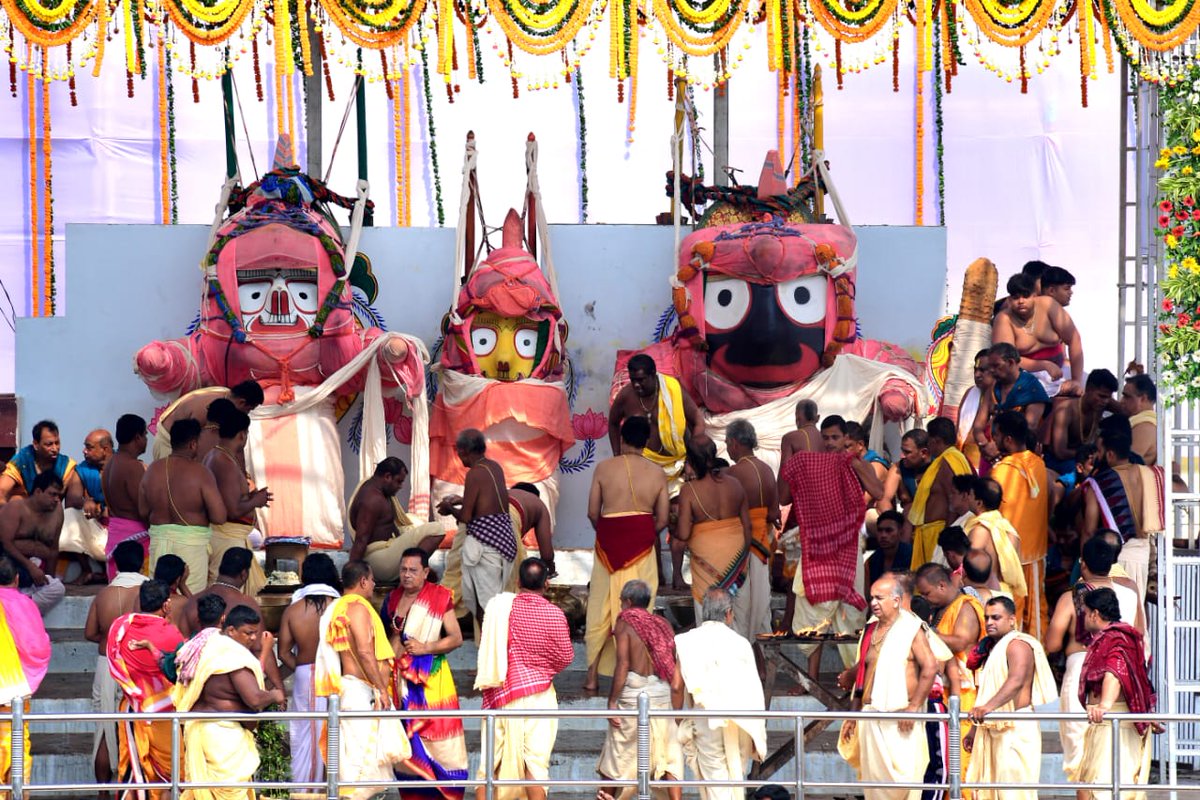
On the full moon day of the month of Jyeshtha, the deities are ceremonially brought from the sanctum to the Snana Bedi, where they are bathed with one hundred and eight pots of sanctified water in the presence of thousands of devotees. The movement from the innermost shrine into the open is one of the most distinctive features of the Jagannath tradition. It transforms what could have remained an enclosed temple ritual into a public expression of faith and shared cultural memory.
The symbolism of this movement deserves careful reflection. Every temple has walls that define its sacred precincts. The sky has none. By placing the deities beneath the limitless heavens, the tradition quietly proclaims that while temples are sacred centres of worship, the Divine cannot be confined within any human structure. For this one extraordinary occasion, the universe itself becomes the temple. The sky forms its roof, the earth its floor, the elements of nature participate in worship and humanity gathers as one congregation. This image carries a philosophical depth that speaks not only to devotees but also to anyone interested in the enduring relationship between the sacred and the natural world.
Spiritually, the Snana Yatra does not imply that the Divine requires purification. Rather, the ceremonial bath symbolises the devotee’s own aspiration for inner renewal. In Indian thought, water signifies life, compassion and purification. As the deities are bathed, worshippers are invited to examine and cleanse their own hearts of pride, anger, greed and prejudice. The outward ceremony thus becomes an inward discipline. The ritual teaches that true spirituality begins with the transformation of human consciousness.
The period of Anasara, which follows the ceremonial bath, deepens this spiritual insight. Within the Jagannath tradition, the deities withdraw from public view before returning during the Ratha Yatra. This symbolic interval conveys a lesson that remains relevant in every age. Renewal requires rest, reflection and recovery. A society that values only constant activity risks losing its inner balance. By incorporating withdrawal and restoration into the annual cycle of worship, the tradition acknowledges that strength is sustained not only by action but also by contemplation.
Historically, the Snana Yatra reflects the remarkable continuity of Indian civilisation. It has endured through changing dynasties, political transitions, colonial rule and the emergence of modern India. Its survival is more than the preservation of an ancient custom. It demonstrates the capacity of a living civilisation to transmit cultural memory across generations while allowing each age to interpret inherited traditions in the light of new experiences. Priests, artisans, servitors, devotees and scholars have together sustained this remarkable continuity.
The Jagannath tradition itself is a unique example of cultural synthesis. Over the centuries, it has drawn strength from tribal traditions, classical Hindu philosophy, devotional movements and regional practices. The Snana Yatra reflects this inclusive character. It does not erase diversity but harmonises it within a shared experience of reverence. In doing so, it offers a compelling model of cultural integration that remains relevant in a plural society.
Anthropologically, public rituals perform functions that extend well beyond religion. They strengthen collective memory, reinforce social identity and nurture a sense of belonging. The Snana Yatra illustrates these functions with exceptional clarity. Pilgrims from different regions, languages and social backgrounds assemble before the same altar, united by a common experience that transcends ordinary distinctions.The ceremony reminds us that communities are held together not only by institutions and laws but also by shared symbols and collective participation.
The public character of the Snana Yatra also offers a significant social message. In many religious traditions, the most sacred rituals remain within the sanctum, witnessed only by a few. The Jagannath tradition presents a different vision. The Lord comes out before the people. This symbolic movement is deeply meaningful. Instead of requiring every devotee to reach the Divine, the Divine reaches out to humanity. It is a powerful expression of accessibility, compassion and inclusiveness. In a wider civic sense, it also reminds us that institutions inspire confidence when they remain open, visible and responsive to the people they serve.
The festival carries equally profound psychological insights. Contemporary psychology has demonstrated that meaningful collective rituals foster emotional resilience, strengthen social trust and reduce the sense of isolation that increasingly characterises modern life. Long before such ideas entered academic discourse, Indian civilisation had developed public ceremonies that naturally nurtured these human needs. The shared experience of witnessing the Snana Yatra creates a feeling of belonging that transcends individual concerns. Thousands gather not merely to observe a ritual but to participate in a collective affirmation of hope, continuity and faith.
The symbolism of Anasara further enriches this psychological understanding. After the ceremonial bath, the deities retire from public view before returning during the Ratha Yatra. Within the Jagannath tradition, this interval symbolises recovery and renewal. Whether understood devotionally or metaphorically, it conveys an enduring truth. Rest is not the opposite of meaningful action but one of its essential conditions. Human beings, institutions and even civilisations require moments of reflection if they are to preserve their vitality. The ritual thus anticipates a principle increasingly recognised in modern studies of mental health and human wellbeing.
The philosophical significance of the Snana Yatra reaches still deeper. Indian philosophy understands the universe as an interconnected reality rather than a collection of isolated entities. Among the five great elements, Akasha, or space, occupies a unique place. Earth provides stability, water sustains life, fire transforms, air animates and Akasha embraces them all. It symbolises openness, infinity and the boundless reality within which existence unfolds.
When the deities are placed beneath the open sky, the ritual acquires a profound philosophical dimension. The temple represents sacred space created by human devotion. The limitless heavens represent the Infinite that no human structure can contain. The movement from the sanctum to the open altar symbolically unites the finite with the infinite. It reminds us that while places of worship remain indispensable centres of spiritual life, the Divine ultimately transcends every boundary of architecture, geography and human imagination.
This vision resonates with the wisdom of the Upanishads, where the Infinite is understood as the ground of all existence. The open sky above the Snana Bedi silently conveys this truth. It invites humility before the vastness of creation, openness towards others and reverence for a reality greater than oneself. In a single visual image, the ceremony expresses what philosophical texts often explain through complex reflection.
Water enriches this symbolism further. It purifies without discrimination, nourishes every form of life and continually renews itself through the rhythms of nature. The ceremonial bathing of the deities with one hundred and eight pots of sanctified water therefore represents more than ritual observance. It symbolises continuity, renewal and the interdependence of all life. The recurring use of the number one hundred and eight in Indian spiritual traditions also reflects an ancient attempt to relate ritual practice with broader patterns perceived in nature and the cosmos. Whether interpreted symbolically or culturally, it points towards an enduring search for harmony between human life and the universe.
The ecological wisdom embodied in the Snana Yatra deserves renewed attention today. Long before environmental conservation became a global concern, Indian civilisation cultivated reverence for rivers, forests, mountains, trees and the natural elements. Such reverence encouraged responsibility rather than exploitation. By conducting one of its most significant ceremonies in the presence of the sky, air and water, the Jagannath tradition reminds us that nature is not merely the setting of spiritual life but one of its essential participants.
Modern environmental science has reinforced the importance of living in balance with ecological systems. Climate change, declining biodiversity and environmental degradation have demonstrated the consequences of ignoring this relationship. Although the Snana Yatra emerged in a very different historical context, its symbolism continues to speak with remarkable relevance. It encourages an ethic of stewardship founded upon gratitude, restraint and coexistence rather than domination over nature.
The enduring relevance of the Snana Yatra lies in its extraordinary ability to communicate profound truths through a simple public ceremony. It speaks simultaneously to faith and reason, tradition and modernity, individual devotion and collective responsibility. While rooted in the sacred traditions of Odisha, its message reaches far beyond regional or religious boundaries. It raises questions that concern every civilisation. How should human beings relate to nature? Can ancient rituals continue to guide modern societies? What gives enduring meaning to community life? The Snana Yatra responds not through abstract arguments but through the eloquence of symbolism.
Modern civilisation has achieved remarkable advances in science and technology, yet it also faces unprecedented environmental degradation, social fragmentation, loneliness and declining public trust. These challenges cannot be addressed by material progress alone. They demand ethical imagination, cultural continuity and a renewed awareness of humanity’s place within the larger order of existence. Ancient traditions remain relevant when they preserve such wisdom in forms that continue to inspire successive generations.
The Snana Yatra reminds us that reverence for nature is not opposed to progress. By placing water, air, sunlight and the limitless sky at the heart of a sacred observance, it affirms that the natural world is not merely a resource to be used but a partner in sustaining life. This vision resonates strongly with contemporary environmental ethics, which call for responsible stewardship rather than unrestrained exploitation.
The ceremony also offers a lesson in public life. The Lord emerges from the sanctum and stands before the people. This movement symbolises a relationship founded on accessibility, compassion and participation. It reminds us that genuine authority is strengthened when it remains connected with those whom it serves. Though expressed through a religious ritual, the underlying principle possesses a universal civic relevance.
For scholars, the Snana Yatra demonstrates how ritual can preserve philosophical ideas across centuries. For anthropologists, it reveals the power of shared ceremonies in shaping cultural identity. For psychologists, it illustrates how collective participation nurtures emotional resilience and social belonging. For environmental thinkers, it affirms the intimate relationship between humanity and the natural world. For philosophers, it points towards the Infinite through the language of symbol rather than abstract speculation. For devotees, it remains a living expression of faith, love and surrender. Few traditions speak meaningfully to so many dimensions of human inquiry.
The true greatness of the Snana Yatra therefore lies not merely in the splendour of its rituals but in the breadth of its vision. It transforms a ceremonial bath into a meditation on existence itself. It reminds us that authentic spirituality does not separate humanity from the world but reconnects it with nature, society and the transcendent. It teaches that faith finds its noblest expression in openness rather than exclusion, in harmony rather than domination and in shared humanity rather than division.
As the deities return to the sanctum after the sacred observance, one image remains engraved in the minds of countless pilgrims. Beneath the boundless sky, the Lord stands before humanity without distinction of caste, creed, language or social status. For a brief yet unforgettable moment, the temple symbolically expands into the universe. The sky becomes its dome, the earth its altar, the elements of nature its companions and humanity its congregation.
That image explains why the Snana Yatra has endured through the centuries and why it continues to inspire fresh reflection in the present age. It quietly proclaims a timeless truth: the widest temple has no walls and no roof. It is the universe itself. Beneath that infinite canopy, Jagannath reminds humanity that the sacred belongs to all, nature is worthy of reverence, and the path to a more compassionate world begins with recognising the unity of creation.