



























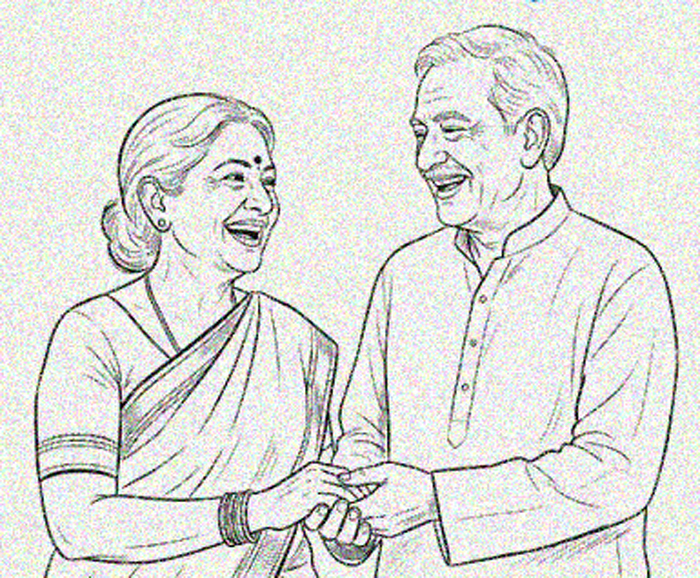
The International Day of Older Persons should not remain a one-day ceremony of speeches and programmes. It should become an opportunity to rethink our attitude towards ageing. Let us move from “caring for the elderly” to “caring with the elderly.”
October 1 is observed every year as the International Day of Older Persons, reminding the world of the dignity, rights, wellbeing and contributions of older people. The United Nations General Assembly designated October 1 as the International Day of Older Persons in 1990, and the first observance took place in 1991. The 2026 theme, “The Age of Longevity: Rethinking Systems for Longer Lives,” is particularly relevant as people live longer and societies undergo major demographic and social changes.
It calls for rethinking not only healthcare and social protection, but also how longer lives can be lived with dignity, participation, purpose and meaningful engagement.
But another question deserves equal attention: What are we doing with the experience, knowledge and wisdom accumulated by older persons?
An elderly person is not merely someone who has crossed a particular age. Six or seven decades of life may contain invaluable experience of family, agriculture, administration, science, profession, relationships, culture and crises. The younger generation may be faster with smartphones, social media and artificial intelligence, but speed of information is not the same as depth of understanding. A machine can provide information within seconds; experience helps us judge how that information should be used.
This makes the experience of older persons especially valuable today. We live in an age of rapid technological change, information overload and uncertainty. Artificial intelligence can process enormous quantities of information, but human beings must decide what is useful, ethical and humane.
Technology can calculate; wisdom must help us decide.
Yet modern progress has created a paradox. We are technologically more connected but, in many families, emotionally less connected. Members of the same household may sit together while each remains absorbed in a separate screen. Conversations over meals are sometimes replaced by scrolling, messaging and watching videos. A family may have a social-media group containing everyone and still lack meaningful communication.
Technology itself is not the enemy. Social media, artificial intelligence, telemedicine and digital communication can greatly improve the lives of older people and connect families separated by distance. The problem begins when technology becomes a substitute for human presence rather than a means of strengthening it.
Older parents can experience this emotional distance particularly deeply. Employment, migration, nuclear families and changing lifestyles may reduce opportunities for conversation. Some parents eventually move into old-age homes. Such homes can provide companionship, healthcare and security and are not necessarily symbols of neglect. But when an elderly person feels unwanted, unheard or emotionally disconnected from the family, society must pause.
The question is not only, “Who is taking care of the elderly?” It is also, “Who is listening to them?”
Food, medicine, shelter and financial security are essential, but human beings also need recognition, affection, respect, conversation and belonging. An elderly mother may value an hour of conversation more than an expensive gift. An elderly father may need less another digital device than someone willing to listen to his memories, concerns and advice.
There is an old famine story, told in different forms, in which a community is devastated by drought. The younger generation has discarded the knowledge of an old man, considering his traditional experience outdated. As the crisis deepens and starvation threatens everyone, his son secretly seeks his father’s advice. The old man remembers a drought-resistant crop and traditional methods of conserving water and protecting the soil. His advice is finally followed, and knowledge once considered obsolete helps save the community.
The importance of this story is not whether every detail belongs to a documented historical event. Its message is universal: when a society discards the knowledge of its elders, it may discover its value only when a crisis arrives.
Human survival has always depended on intergenerational learning. Before books, databases and artificial intelligence, knowledge travelled through observation, memory, storytelling and practice. Older people carried knowledge of seasons, crops, local ecology, traditional skills and ways of responding to hardship. Much of this knowledge was never formally recorded.
Modern research also recognises that wisdom is more than accumulated information. It can involve self-reflection, emotional regulation, compassion, social understanding, tolerance of uncertainty and sound judgement. Age alone does not make a person wise, but life experience, when combined with reflection, can develop forms of understanding that younger people may not yet possess.
Indian philosophical traditions have long distinguished knowledge from wisdom. Knowledge tells us what something is; wisdom helps us understand how and when that knowledge should be used. This intergenerational transmission of experience was once naturally embedded in the family system.
The joint family has changed, and we cannot simply demand a return to the past. Modern families, migration and professional mobility are realities. What needs restoration is not necessarily the old family structure but the spirit of intergenerational respect and learning.
This is where the 2026 theme acquires a deeper meaning. Rethinking systems for longer lives should not mean designing systems merely to care for older people. It should mean designing systems with older people as active participants.
A retired scientist can mentor young researchers. A former administrator can guide young professionals. An experienced farmer can teach sustainable agricultural practices. A retired engineer can mentor students. An artist can transmit traditional skills. A former professional can advise young entrepreneurs. A socially active senior citizen can contribute to community service.
The key is meaningful assignment.
Older persons who are capable and willing should not simply be given activities to keep them occupied. They should be offered responsibilities they enjoy, suited to their experience, interests and abilities. A few hours of mentoring, guiding, documenting traditional knowledge, supporting schools, advising community organisations or helping younger professionals can give retirement a new sense of purpose.
The objective should be to move from “keeping the elderly occupied” to “engaging their wisdom.” Such engagement benefits both generations. The younger generation gains experience, while the older generation gains recognition and purpose. Retirement should mean freedom from compulsory employment, not retirement from usefulness.
Imagine a retired person receiving a call: “We need your experience. Would you like to guide these young people?” Such words can restore dignity and belonging.
Artificial intelligence can become an ally in this process. Young people can teach older persons digital skills, while older persons can contribute human judgement and ethical perspective. Oral histories can be recorded, traditional knowledge preserved and family memories documented. Digital tools can connect grandparents with grandchildren across geographical boundaries.
But AI should never replace the human relationship between generations. The younger generation must also remember that ageing is not somebody else’s problem. Every surviving human being is travelling towards old age. The way society treats older people today helps shape the society in which today’s young people will grow old tomorrow.
Therefore, the International Day of Older Persons should not remain a one-day ceremony of speeches and programmes. It should become an opportunity to rethink our attitude towards ageing. Let us move from “caring for the elderly” to “caring with the elderly.”
Let us move from seeing them merely as dependants to recognising them as contributors.
Let us stop asking only, “How can we keep them occupied?” and begin asking, “What meaningful work would they enjoy doing for the next generation?” The world is entering an age of longevity. The challenge is not simply to add years to life, but to add life to those years, purpose to that life and wisdom to the future.
Artificial intelligence represents intelligence accumulated in machines. Older persons represent something equally precious: wisdom accumulated through life.
We should bring the two together. Because a society that preserves its technology but loses its wisdom may become more efficient without necessarily becoming more humane. Longevity with dignity, meaningful engagement and intergenerational service can become not merely a longer life, but a gift to the future.
An ageing society must not ask only how to care for its older people; it must also ask how to make them feel valued, heard, loved and meaningfully connected with the generations that will inherit their world.
Every elderly person is a living chapter of a family’s history and a society’s memory. When we listen to that chapter with respect, we do not merely honour the past; we help the future understand itself.