




















Chief minister Mohan Majhi has been winning praise for his efforts to take Odisha forward, especially in the field of industrialization. But his vision is not restricted to this area alone. He has been taking note of other important issues and resolving them to ensure smooth progress.
Chief minister Mohan Charan Majhi’s hard work to ensure that Odisha finds a place among the top-ranking states of the country has won praise from many including Prime Minister Narendra Modi. The most important proof of Modi’s liking for the state’s first BJP chief minister is his readiness to visit Odisha whenever he is invited by Majhi. Odisha is among the few states of the country Modi has visited so many times within the span of a year.
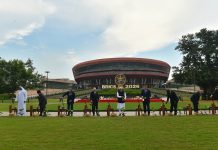
Modi was effusive in his praise of Majhi when he addressed the state-level function to celebrate the completion of one year in office by the new government. He said that that chief minister and his team has not only made commendable progress within a short span of time but also lived up to the expectations of the people.
Describing Odisha as a radiant beacon of India’s rich heritage he assured the chief minister of his complete support, pointing out that his government was investing thousands of crores to enhance road, rail and air connectivity in the state and also supporting its industrialization drive.
The praise was well deserved with the chief minister making progress on all fronts with industrialization being one of the most important areas of development. During the investment conclave organised in Bhubaneswar the state attracted record-breaking investment proposals worth nearly `17 lakh crore. The chief minister has been trying hard to transform Odisha into a leading industrial hub of Eastern India so that BJP’s slogan of Purvoday or rise of the East becomes a reality.
But this is not the only area where the state has made progress. The chief minister has kept a sharp eye on the problems of the people and made every possible effort to make things easy for them. One of the latest moves in this direction is the plan to introduce a queue-based darshan system for devotees visiting the Puri Jagannath Temple, the spiritual nerve centre of Odisha. The devotees usually enter the shrine through barricades erected by the administration but struggle for smooth darshan at the Natamandap – the dance hall opposite the sanctum sanctorum – due to overcrowding and lack of an organized system.
The temple managing committee recently discussed the ‘dhadi’ (queue) darshan system inside the Natamandap and approved a proposal in this regard. “A committee has been formed under the chairmanship of Puri collector that will discuss with various servitors’ groups about the queue darshan system, its viability and other aspects. The committee will ensure that rituals of deities shouldn’t be hampered because of the queue darshan system. So, we have decided to introduce it on an experimental basis before its full-scale introduction,” said chief temple administrator Arabinda Padhee after the temple managing committee meeting.
A standard operating procedure will soon be issued for the introduction of the ‘dhadi’ darshan system and a six-lane ramp will be erected within the Natamandap with special arrangements for old-age persons, women, differently-abled and VIPs. For the convenience of devotees inside the Natamandap, the Archaeological Survey of India (ASI), custodian of the temple, has allowed the administration to install air-conditioning systems.
Another important development has been in the direction of finding an amicable solution to vexed issue of sharing the Mahanadi waters between Odisha and Chhattisgarh, two states which are now being run by BJP governments. This has raised hopes of a solution to the issue pending with the Mahanadi Water Disputes Tribunal since 2018.
A beginning was made when Odisha Chief Minister Mohan Charan Majhi, who chaired a meeting on the issue in July, wrote to his Chhattisgarh counterpart Vishnu Deo Sai seeking a “mutually beneficial settlement”. Sai responded to Majhi saying the former’s proposal is under “active consideration”.
In his letter, Majhi has proposed a joint committee led by officials of the Central Water Commission and comprising officials from both the states to facilitate dialogue and technical negotiations to reach a “mutually beneficial settlement”.
“With our collective effort and active cooperation of both states and the Central Water Commission, we can achieve a just, equitable, and timely resolution to this pressing issue. Such a resolution will not only bring about peace and stability but also foster greater cooperation, trust, and goodwill between Odisha and Chhattisgarh, paving the way for future collaborations,” the Odisha CM said in his letter. Official sources said chief secretaries of both the states have held initial discussions on the issue.
Mahanadi that flows through Chhattisgarh and Odisha is a major source of water in both the states for agriculture, industry and hydropower generation. In Odisha people of as many as 17 districts depend on its waters for survival. The river has a total catchment area of 141,600 square kilometres, of which 53.9 per cent is in Chhattisgarh, 45.73 per cent in Odisha and a very small part in Madhya Pradesh.
As the river caused massive flooding, Odisha in 1953 had constructed a massive 25-km long earthen dam at Hirakud in Sambalpur district to reserve water for irrigation facilities in western region of the state and for power generation. Odisha in 2016 claimed a minimum flow of 12.28-million-acre feet of Mahanadi water at Hirakud dam.
The fresh proposal by the Odisha government for an amicable solution to the issue assumes significance with the BJP in power in both the neighbouring states and at the Centre. The current political dispensation in both the states and at the Centre has created a good opportunity to find an amicable solution to the river water dispute.
The two states locked horns over Mahanadi water since 2016 after Odisha alleged ‘unilateral’ construction of multiple barrages by Chhattisgarh in the upper catchment areas that resulted in reduction of flow into Odisha, the lower riparian state, during non-monsoon seasons. Though the Centre initially tried to resolve the issue mutually with the then Union Water Resources Minister Uma Bharti holding a tripartite meeting attended by then chief ministers Naveen Patnaik and Raman Singh in September 2016, the then BJD government insisted on a tribunal to resolve the issue.
It also moved the Supreme Court in November 2016 against Chhattisgarh’s “unilateral construction” of barrages over Mahanadi. Following a Supreme Court order in January 2018, the Centre in March that year constituted the three-member Mahanadi Water Disputes Tribunal. Thanks to the sagacity of chief minister Mohan Majhi after a long time a resolution to the dispute seems possible.