





























The campaign in Bengal has been nothing short of electrifying. It has witnessed fierce rhetoric, massive rallies, and unprecedented mobilization of resources. The BJP’s campaign has focused heavily on issues such as alleged corruption, political violence, and governance deficits under the TMC regime.
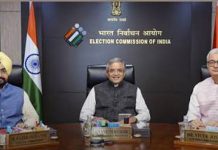
As elections unfold across five crucial states—Keralam, Tamil Nadu, Puducherry, Assam, and West Bengal—the nation’s political attention has unmistakably converged on Bengal. While each of these states holds its own strategic importance, it is Bengal that has evolved into the central theatre of a high-stakes political confrontation. The results, scheduled to be announced on 4th May, are expected to shape not just regional dynamics but the broader national political discourse.
Why Bengal Matters Most
Among the five states, West Bengal stands apart—not merely because of its size or political history, but due to the intensity of the contest. The ruling All India Trinamool Congress (TMC), led by Chief Minister Mamata Banerjee, faces an aggressive and determined challenge from the Bharatiya Janata Party (BJP).
For the BJP, Bengal represents the final frontier in its quest for pan-India political dominance. Having expanded its footprint across much of northern, western, and northeastern India, capturing Bengal would signify not just a territorial victory, but an ideological breakthrough in a state historically resistant to its politics.
The party’s resolve is evident from the sustained presence of its top leadership. Union Home Minister Amit Shah—often described as the BJP’s chief strategist—has camped in the state for extended periods, overseeing campaign operations with remarkable intensity. Prime Minister Narendra Modi has also addressed multiple high-voltage rallies, signaling the importance the party attaches to this election.
The Electoral Landscape: Seats and Past Results
The West Bengal Legislative Assembly comprises 294 seats, making it one of the largest state assemblies in India. A party or coalition needs 148 seats to secure a simple majority.
In the 2021 Assembly elections, the results were overwhelmingly in favor of the TMC:
TMC: 215 seats
BJP: 77 seats
The BJP, which had won only 3 assembly seats in 2016 assembly poll, had improved its tally to 77 in 2021 poll. However, the political landscape had undergone a dramatic shift during the 2019 Lok Sabha elections, where the BJP surged to win 18 out of 42 parliamentary seats from Bengal, significantly denting the TMC’s dominance. In 2024 Lok Sabha polls, BJP however had won only 12 Lok Sabha seats against AITC’s 29 seats.
This transformation has set the stage for the current electoral battle, where the BJP is no longer a marginal player but a formidable challenger.
A High-Decibel Campaign
The campaign in Bengal has been nothing short of electrifying. It has witnessed fierce rhetoric, massive rallies, and unprecedented mobilization of resources. The BJP’s campaign has focused heavily on issues such as alleged corruption, political violence, and governance deficits under the TMC regime.
On the other hand, Mamata Banerjee has positioned herself as the “daughter of Bengal,” emphasizing regional pride and portraying the BJP as an outsider force attempting to impose its will on the state.
The deployment of a large contingent of central forces has added another layer of complexity. While the BJP argues that such deployment is necessary to ensure free and fair elections, the TMC has alleged that it is a tactic to influence the electoral process.
Phase-wise Voting and Early Trends
The Bengal election is being conducted in multiple phases, a reflection of both its scale and sensitivity.
First Phase Observations: Early reports from the initial phase indicated a high voter turnout, often seen as a sign of voter enthusiasm and a desire for change. Political analysts suggest that high turnout in certain constituencies could favor the BJP, particularly in regions where anti-incumbency sentiments are strong.
Second Phase Indicators: The second phase has shown mixed signals. While rural belts appear to maintain loyalty to the TMC, urban and semi-urban areas have demonstrated a more competitive contest. Minority-dominated regions, traditionally supportive of the TMC, have largely remained aligned with Mamata Banerjee, potentially consolidating her vote base.
However, the BJP has made inroads among sections of the Scheduled Castes, Scheduled Tribes, and urban middle-class voters—groups that could prove ‘Nirnayak’ in close contests.
What Experts Are Saying
Political analysts remain divided, reflecting the unpredictable nature of the contest. One senior election observer remarked, “This is perhaps the closest election Bengal has witnessed in decades. The BJP has successfully transformed itself into the principal opposition, but converting momentum into seats remains the real challenge.”
Another psephologist noted, “Mamata Banerjee’s personal popularity and welfare schemes still give the TMC a strong edge. However, the BJP’s organizational strength and narrative-building cannot be underestimated.”
A Kolkata-based political scientist added, “The election is not just about governance—it’s about identity, culture, and the idea of Bengal itself. That makes the outcome far more complex than a simple anti-incumbency versus pro-incumbency contest.”
Possible Outcomes: Two Scenarios
Scenario 1: BJP Victory – If the BJP manages to cross the majority mark, it would mark a historic political shift. Such a victory would:
Establish the BJP as a truly pan-Indian party with presence across all major regions,
Deliver a severe blow to regional parties,
Strengthen the party’s narrative ahead of future national elections.
It would also raise questions about the future of the TMC and the viability of regional political forces in resisting the BJP’s expansion.
Scenario 2: TMC Retains Power – A victory for the TMC would be equally significant, albeit for different reasons:
It would reaffirm Mamata Banerjee’s stature as one of the most formidable regional leaders in India,
Provide a morale boost to opposition parties across the country,
Demonstrate that strong regional identities can counter national-level political narratives.
Such an outcome would likely encourage greater opposition unity in future electoral battles.
The Stakes Beyond Bengal
While the election is geographically confined to West Bengal, its implications are national. The outcome will influence political strategies, alliances, and narratives across India.
For the BJP, a win would validate its aggressive expansion strategy. For the opposition, a TMC victory would serve as proof that the BJP can be challenged—and defeated—in direct contests.
Conclusion: Awaiting a Defining Verdict
As the state moves through the remaining phases of polling, anticipation continues to build. The people of West Bengal are not just electing a government—they are shaping the trajectory of Indian politics.
The results on 4th May will do more than declare a winner. They will set the tone for the country’s political discourse in the years to come.
Whether it is the BJP’s quest for dominance or the TMC’s fight for survival, Bengal stands at the crossroads of history. The verdict, when it arrives, will echo far beyond the boundaries of the state.