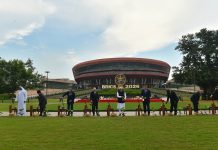










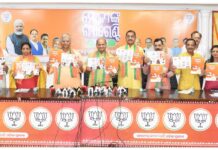











Modi’s journey, from an RSS pracharak to a three-term Prime Minister, mirrors the organisation’s own rise in scale and influence. His mention of the organisation from the ramparts of the Red Fort was tribute to it.
Having begun his career as an RSS pracharak or volunteer Prime Minister Narendra Modi has always held the organisation, which serves as the ideological foundation of BJP, in the highest regard.
However, RSS chief Mohan Bhagwat’s remarks last month at a function suggesting that leaders should step aside at the age of 75 has sparked a political controversy with some Congress leaders interpreting them as a message to Modi, who will turn 75 next month, that he should make way for others.
However, it now appears that Bhagwat’s remarks were misinterpreted, perhaps to embarrass Modi. What Congress leaders don’t know is that Modi’s relationship with the RSS remains deep and unlikely to be disrupted by such pinpricks.
In his Independence Day address the Prime Minister hailed the RSS on its centenary, calling it the world’s biggest NGO. His words not only reflect his respect for the organisation but also his gratitude for its physical and ideological support to the BJP. The RSS will complete 100 years on Vijaya Dashami this October.
Modi’s remarks about the RSS carry political importance as in recent years there have been murmurs of strains in the RSS-BJP relationship. By heaping praise on the organisation which happens to be BJP’s ideological fountainhead Modi appeared to signal everything was fine between BJP and RSS. The mention also makes it clear that RSS remains central to BJP’s ideology of national service.
Modi said, “Today, I would like to proudly mention that 100 years ago, an organisation was born, the Rashtriya Swayamsevak Sangh. Hundred years of service to the nation is a proud, golden chapter. With the resolve of ‘vyakti nirman se rashtra nirman’, with the aim of welfare of Maa Bharati, swayamsevaks dedicated their lives to welfare of our motherland.”
Modi’s journey, from an RSS pracharak to a three-term Prime Minister, mirrors the organisation’s own rise in scale and influence. His mention of the organisation from the ramparts of the Red Fort was tribute to it and also an expression of his indebtedness to it for the role it had played in his own growth as a leader with dedication to national duty.
This was likely an acknowledgement of the RSS’s exemplary social work during emergencies, natural calamities, and rural development – most notably during the Kerala and Assam floods in 2018 and 2022, respectively and cyclone Fani in Odisha. The RSS’s Seva Bharati organisation ran over 1,000 relief camps nationwide during Covid-19. By congratulating the RSS for its role in nation building he brought the organisation into national focus.
Congress MP Jairam Ramesh described his speech as a desperate attempt to appease the RSS in the run-up to his 75th birthday next month. Such criticism was expected but it is unlikely to impact Modi’s relationship with the organisation that shaped him in his initial years of growth.
The rapport between RSS chief Mohan Bhagwat and Modi has long combined shared ideology, but in recent years, observers and Opposition leaders have pointed to some strain. But there have also been gestures of solidarity which make it clear that all the talk of difference is merely speculative.
One would recall that Bhagwat had met Modi at his residence just days before Operation Sindoor. Modi had made his first visit as PM to the RSS headquarters in Nagpur. During this visit the Prime Minister emphasised that, despite being a powerful chief executive, securing a third consecutive term, his foremost identity was that of a Swayamsevak. He continues to have the same respect for his alma mater.