





















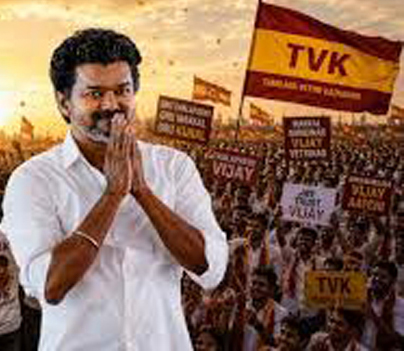
Since the late 1960s, no political force outside the Dravidian fold had successfully captured power in the state. Yet Vijay, a man with no administrative experience and barely three years into active politics, rewrote history by leading TVK to emerge as the single largest party in the Assembly.
The political landscape of Tamil Nadu witnessed a historic transformation after the recent Assembly election results, as actor-turned-politician Vijay emerged as the new Chief Minister following the spectacular success of his party, Tamilaga Vettri Kazhagam (TVK).
For decades, Tamil Nadu politics revolved around two towering Dravidian parties — Dravida Munnetra Kazhagam (DMK) and All India Anna Dravida Munnetra Kazhagam (AIADMK). Since the late 1960s, no political force outside the Dravidian fold had successfully captured power in the state. Yet Vijay, a man with no administrative experience and barely three years into active politics, rewrote history by leading TVK to emerge as the single largest party in the Assembly.
The rise of Vijay is not merely an electoral victory. It represents a generational shift in Tamil Nadu politics — a transition from traditional Dravidian rhetoric to personality-driven, youth-centric politics powered by cinema, social media, and grassroots mobilisation.
A Childhood Born in Cinema
Born as Joseph Vijay Chandrasekhar on June 22, 1974, in Chennai, Vijay grew up in a family deeply connected to the film industry. His father, S. A. Chandrasekhar, was a noted filmmaker, while his mother, Shoba Chandrasekhar, was associated with music and cinema.
Vijay entered films as a child artist before making his debut as a lead actor in the early 1990s. Initially criticised for his acting and screen presence, he slowly transformed himself into one of the biggest superstars of South Indian cinema.
Films like Ghilli, Thuppakki, Mersal and Leo elevated him into a mass hero with an enormous fan following among youth and lower-middle-class audiences.
Unlike many actors who remained confined to cinema glamour, Vijay built a disciplined fan network across Tamil Nadu. His fan clubs gradually evolved into welfare organisations conducting blood donation camps, relief work during floods, and educational assistance programs. These networks later became the backbone of his political machinery.
The Entry into Politics
Vijay formally launched Tamilaga Vettri Kazhagam in 2024. Political observers initially dismissed the party as another celebrity experiment, similar to many short-lived regional outfits.
However, Vijay adopted a different strategy. Instead of immediately attacking all opponents, he focused on: Anti-corruption messaging, youth employment, governance reforms, education and Tamil identity with inclusive nationalism.
His speeches were carefully crafted to appeal both to traditional Dravidian voters and to first-time young voters frustrated with decades of political rivalry between DMK and AIADMK.
Importantly, Vijay avoided extreme ideological positions. This helped TVK attract urban middle-class voters, women, unemployed youth, and even sections of minority communities.
How Vijay Defeated the Dravidian Giants
For nearly fifty years, Tamil Nadu politics was controlled by leaders shaped by the Dravidian movement — from M. Karunanidhi and J. Jayalalithaa to M. K. Stalin and later AIADMK leaders.
But several political developments weakened the traditional structure:
- Leadership Vacuum: After the deaths of Karunanidhi and Jayalalithaa, both DMK and AIADMK lost the towering personalities that once emotionally connected with voters.
- AIADMK Split: Internal conflicts weakened All India Anna Dravida Munnetra Kazhagam. Rival factions fought for leadership and cadre control. Many second-rung leaders and local organisers reportedly shifted towards Vijay, seeing him as a fresh alternative capable of defeating DMK. A significant section of AIADMK supporters believed Vijay could inherit the mass appeal once enjoyed by Jayalalithaa and M. G. Ramachandran (MGR).
- Cinema and Politics Connection: Tamil Nadu has a unique history where cinema and politics are deeply intertwined. Legends like: C. N. Annadurai, M. Karunanidhi, M. G. Ramachandran and J. Jayalalithaa used cinema as a political communication tool. Vijay successfully revived this formula for the digital era. His film dialogues, songs, and screen image had already built a “protector of common people” perception among fans.
- Youth Wave: TVK’s biggest strength was the youth vote. Social media campaigns, volunteer-driven outreach, and Vijay’s clean public image created a strong emotional movement across the state.
A Rare Political Achievement
Winning power in the very first major election is extraordinarily rare in Indian politics. Vijay now joins a select group of leaders who achieved remarkable electoral breakthroughs soon after entering politics.
- T. Rama Rao: The Telugu film superstar founded the Telugu Desam Party in 1982 and became Chief Minister of Andhra Pradesh within months, ending Congress dominance.
- G. Ramachandran: MGR formed AIADMK after splitting from DMK and quickly became one of Tamil Nadu’s most beloved leaders.
Arvind Kejriwal: Though not from cinema, Kejriwal’s Aam Aadmi Party rose rapidly and formed government in Delhi soon after its creation.
Jagan Mohan Reddy: After creating YSR Congress Party, he built a massive support base and swept to power.
Yet Vijay’s success stands apart because he challenged an entrenched Dravidian political structure that had dominated Tamil Nadu for generations.
Beyond Stardom: The Real Challenge Begins
Winning an election is only the first step. Governance will now determine whether Vijay’s rise becomes a long-term political revolution or merely an emotional electoral wave.
Tamil Nadu faces serious challenges: industrial competition, water disputes, unemployment, urban infrastructure pressure and balancing welfare with fiscal discipline.
Vijay’s supporters see him as a reformer capable of bringing administrative transparency and youthful energy. Critics, however, question whether cinematic charisma alone can sustain governance. Still, his journey from film sets to the Chief Minister’s office is already one of the most dramatic political stories in modern India.
The boy who once entertained millions on screen has now become the most powerful political figure in Tamil Nadu — proving once again that in Tamil politics, cinema remains not merely entertainment, but a pathway to power.