


























Odisha’s bhakti sangeet is greatly influenced by famous personalities like Kabisurya Baladeva Rath and Sri Jayadeva. The music that accompanies Odissi dance draws its sustenance from the lyrics of the treasure trove built by renowned saint poets.
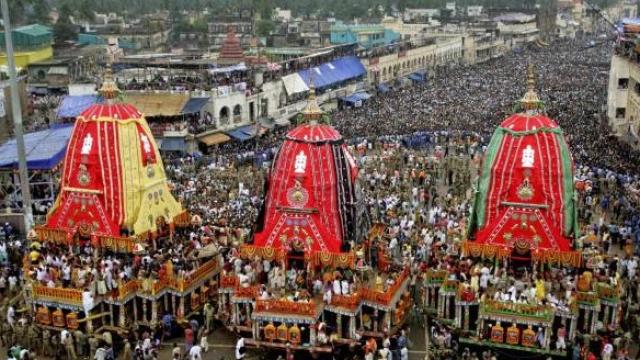
The biggest festival of the world and India is here to the utter delight and deep devotion of the bhaktas. People otherwise also come under the magic spell of this great celebration, characterized by the pulling of the Juggernaut. The synonym is ‘Ratha Yatra’. This festival ‘Ratha Yatra’ brings together millions of devotees in an acoustic symphony of rumbling wooden wheels, rhythmic chanting, blowing of conch shells and the clanging of brass gongs. The whole experience has awe inspiring elements. The classical Odissi dancers perform to the accompaniment of devotional music that has its origins thousands of years back. The sea of humanity spreads out in all directions to form a canvas of frenzied people. The devotional music of Odisha is best showcased on this occasion.
This leads us to the realms of the rich devotional music genre of Odisha. Music be it devotional or otherwise has its origin in the ancient texts of India. The equivalent word for music is termed as Sangita.
The word ‘Sangita’ referred to as “music in English and Mousike in Greek” has interesting connotations. In the Devanagri script sangeeta is also written as ‘Samgita’ and it refers to “music and associated performance arts” in the Indian traditions. According to Guy Beck, the root “saṃ” implies “combining, coming together, convergent wholesome blending, unison” in the context of musical arts. Going by the Puranas and poetic texts such as Kathasaritsagar, a related term Sangita-shastra and Sangita-vidya mean the “art, science or knowledge of singing and dancing with music”. In various parts of India, especially in the eastern, western and southern parts of India, music is a kind of lived tradition.
Coming to the brass tacks of Bhakti sangeet or devotional music it can be explained in terms of a confluence of bhava (sentiment) word composition that evoke genuine feelings of devotion to the All Mighty, musical appeal and providing a calming effect to the senses besides helping a person’s consciousness to transcend the ordinary realms of life.
Traditional Indian culture, in its overall thrust towards the spiritual, promotes moral values and the attitudes of generosity, simplicity and frugality.
The Pancha Sakhas have had a significant impact on Odisha’s religious and sociocultural history. Odisha’s bhakti sangeet is greatly influenced by famous personalities like Kabisurya Baladeva Rath and Sri Jayadeva. The music that accompanies Odissi dance draws its sustenance from the lyrics of the treasure trove built by renowned saint poets. Even to the present day the lyrics are much in use.
Among the devotional poets of Odisha, Salabeg occupies a paramount position. He was an ultimate devotee of Lord Jagannath. Legends woven around his life run into hundreds of pages and are highly inspiring. Renowned Muslim saint Salabeg composed about one hundred fifty devotional songs including eight Sanskrit verses which are called Patitapavanastaka and there are six Bhajanas in Hindi and Bengali languages.
Impact of Jagannath cult on Devotional Music of Odisha
‘Jagannath’ or ‘Juggernaut’ is described by Mark Twain as “the kindest of gods. Any pretensions to rank or caste do not exist within its temple.” The concept of Jagannath, a pan-Indian consciousness and now a universal consciousness was present not only in contemporary Odia literature but also in the treatment of the Jagannath cult.
Lord Jagannath has been accepted as the representative of Odishan people, an embodiment of love, a guiding force behind the cultural heritage of this land, a synthesis of all the Hinduite faiths and finally as the God of the Universe.
Odisha, the land of art and architecture, has not only excelled in art, architecture, music and dance but also has carved a niche in spiritual culture of the world. In the world of spiritual culture, the Jagannath cult has also got worldwide recognition in fostering equality, fraternity, brotherhood, religious tolerance. The cult of Jagannath in fact is syncretic in nature.
Lord Jagannath stands at the apex of Odishan culture. Everything centres around him. Out of 36 servitors of the temple, the servitors for dance, music and percussion have always held a very important place. The morning services start with music seva and the day also end with music when the deity goes to sleep. Odisha is famous for its rituals and festivals. So it is said, in twelve months there are thirteen festivals in Odisha. Needless to say that in all these festivals and rituals music takes a prime role in upholding the age-old tradition of Odissi music.
Brief history of Music tradition in Odisha
If we look back to cultural history of Odisha, we find that musical tradition is more than 2000 years old. Dating back to the rule of Emperor, Kharavela of 1st century B.C. the Odias have developed their creative genius in music and excelled in it. The Odissi music of Chhanda, Chautisa, Janana, Bhajan has its classicism and originality.
Acharya Jayadev a celebrated poet and scholar in Sanskrit language wrote famous Geeti Kabya titled “Geeta Gobinda” in Sanskrit language during the rule of Ananga Bhima Chodaganga Deb (1175-1202). Poet Jayadeb of 12th Century was also an ardent devotee of Jagannath. His “Geeta Gobinda” was sung in the Jagannath temple. The rulers of Ganga dynasty, favoured, that “Geeta Gobinda” should be integral part of puja ceremony of Lord Jagannath as they were Vaishnavites, though earlier, some of them were Shaivites.
Sarala Das, the epic poet of Mahabharat during the rule of Kapilendra Deb, (1452-1479 A.D.) has written about many legends of Lord Jagannath and enlightened Odias with many ragas of Odissi music. Innumerable devotional songs, Bhajans, Jananas, were composed by Odia poets for Lord Jagannath.
Devotional songs of Orissa are those songs which have been composed and sung in honour of the Gods. Some of the major types of devotional songs are: Bhajan, Kirtan, Janana, Chhanda, Odissi, Festival Songs, Kuanra Punei, Chautisa and Pala etc.
Devotional sentiment is the highest and most valuable treasure of humanity and hence needs to be protected. When devotion is elevated to the realm of devotional ideation through music it touches the deepest chords of human hearts and leads to a reawakening of the soul and a new hope for mankind appears. In view of all the above one can say that devotional music can be immensely instrumental in putting neo-humanism in place. In the strife-ridden world of today, a new world order backed by neo-humanism is absolutely called for.
99899301771,