





























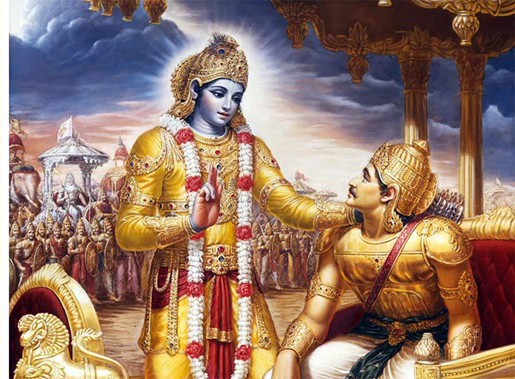
On the battlefield of Kurukshetra, Sri Krishna does not merely give Arjuna an answer. He takes him through a disciplined process of questioning, understanding, discrimination, responsibility and action. In the language of our times, we may call this Krishna’s algorithm for living.
The word “algorithm” belongs to the vocabulary of the modern technological age. We encounter it in discussions about computers, artificial intelligence, social media and digital platforms. In simple terms, an algorithm is a defined sequence of logical steps used to process information, solve a problem or arrive at a decision. It takes inputs, applies rules and produces an outcome. When a search engine selects results, a navigation system finds a route or a social media platform recommends content, an algorithm works silently behind the process. Much of contemporary life is now influenced by such invisible systems.
Yet the fundamental idea behind an algorithm is much older than computers. Human beings have always needed a method to move from a problem to a solution, from uncertainty to clarity and from thought to action. In this broader sense, the Bhagavad Gita offers a remarkably relevant framework for human decision making. On the battlefield of Kurukshetra, Sri Krishna does not merely give Arjuna an answer. He takes him through a disciplined process of questioning, understanding, discrimination, responsibility and action. In the language of our times, we may call this Krishna’s algorithm for living.
The comparison is metaphorical. The Gita is not a technological manual, and Krishna’s teaching cannot be reduced to a computer procedure. The value of the analogy lies elsewhere. Modern algorithms increasingly influence what we see, what we read, what we purchase and what captures our attention. At a time when machines are becoming increasingly capable of processing information and assisting decisions, the deeper question is whether human beings are becoming equally capable of deciding what is right, meaningful and worth pursuing.
Arjuna’s crisis on the battlefield provides the starting point. He is neither ignorant nor incapable. He is an accomplished warrior who knows how to fight. But when he sees his teachers, relatives, friends and elders standing before him, his confidence collapses. His bow slips from his hand, his body trembles and his mind is overwhelmed by sorrow. He knows how to act, but he no longer knows whether he should act.
This is not simply a military dilemma. It is a crisis of judgment in which emotion, attachment, fear, affection and duty have become entangled. Arjuna possesses knowledge, but knowledge alone cannot produce clarity. Krishna therefore begins not with an instruction to act, but with a deeper examination of the condition of the person who must act.
The first principle of Krishna’s method is understand before acting. A confused mind can turn even correct information into a wrong decision. Krishna allows Arjuna’s doubts to emerge and then addresses them through dialogue. The Gita thus begins with a lesson that remains relevant today: before solving a difficult problem, we must first understand its true nature.
Modern life often encourages the opposite. We react instantly to messages, headlines, images and social-media posts. We form opinions from fragments of information and sometimes mistake emotional intensity for truth. Krishna’s approach demands a pause. Reflection is not weakness; it is the beginning of intelligent action.
The second principle is understand yourself. Krishna directs Arjuna beyond the immediate circumstances towards the nature of the self, attachment and desire. Why is Arjuna paralysed? Is his hesitation arising from wisdom or attachment? Is he responding to duty or merely trying to escape emotional pain? These questions are essential because sincerity does not guarantee correctness. A person can honestly feel something and still misunderstand what should be done.
Krishna therefore cultivates viveka, the capacity to discriminate between what is enduring and what is temporary, between impulse and wisdom, and between personal attachment and responsibility. He is not simply supplying information to Arjuna. He is transforming the way Arjuna understands information.
The third principle is identify responsibility. Krishna does not ask Arjuna merely what he wants to do. He asks him to understand his dharma within the circumstances before him. This introduces a dimension largely absent from purely computational decision making. A machine can calculate possibilities, but the human being must determine which values should guide the decision.
This distinction has great relevance today. A student choosing a career, a professional facing an ethical dilemma, a public servant making a difficult decision or a citizen confronted by conflicting claims may all ask, “What do I want?” Krishna invites a deeper question: “What ought I to do?” The first concerns preference; the second concerns responsibility.
The fourth principle is act with dedication. Krishna’s teaching is not an invitation to remain permanently in contemplation. Once understanding has developed, action becomes necessary. This is the spirit of karma yoga. The Gita does not promise Arjuna an escape from difficult circumstances. It teaches him how to act within them.
This leads to one of Krishna’s most famous teachings: “Karmany evadhikaras te ma phaleshu kadachana” (2.47). The verse teaches that one’s sphere of authority is action, not possession of its fruits. It does not mean that consequences are irrelevant or that one should work carelessly. Rather, it warns against becoming so attached to outcomes that anxiety about success or failure destroys the quality of action itself.
This principle is particularly valuable in an achievement driven age. Examination results, promotions, wealth, recognition, professional status and social-media approval can easily become measures of personal worth. When identity becomes dependent upon outcomes, success can produce arrogance while failure can produce despair. Krishna proposes a healthier discipline: give your best to the action within your control while maintaining inner freedom from the result.
The fifth principle is equanimity. Krishna describes samatvam as yoga: the cultivation of inner balance amid changing circumstances. Equanimity does not mean becoming emotionless. It means refusing to allow every success, failure, praise or criticism to determine one’s inner stability.
The sixth principle is conscious choice. After explaining the nature of action, knowledge, duty and liberation, Krishna does something remarkable. In Bhagavad Gita 18.63, he asks Arjuna to reflect fully on what has been taught and then act according to his understanding. Krishna does not demand blind obedience. He does not programme Arjuna; he prepares him to choose.
This is perhaps the most important distinction between Krishna’s “algorithm” and a technological algorithm. A computer algorithm produces an output according to programmed rules. Krishna’s teaching develops the capacity of the human being to make a conscious moral choice. The objective is not mechanical obedience but enlightened responsibility.
The contrast becomes especially significant in the age of artificial intelligence. AI can process vast quantities of information, identify patterns and assist human beings in making decisions. Yet computation alone cannot settle the deepest human question: What ought to be done? That question involves values, responsibility, conscience and purpose.
A digital algorithm may ask, “What are you likely to click?” Krishna’s method asks, “What is worthy of your attention?” A recommendation system may ask, “What do you prefer?” Krishna asks, “Is your preference guided by wisdom?” Technology can help us choose faster; Krishna teaches us to choose better.
This does not make technology an enemy. Algorithms have brought enormous benefits to science, medicine, communication, transportation and education. The challenge is not to reject technological intelligence but to ensure that technological power remains guided by human wisdom. The more powerful our tools become, the more important becomes the quality of the people who use them.
Arjuna’s battlefield, therefore, is not merely an ancient battlefield. It represents the inner conflicts that every generation encounters. We face competing desires, responsibilities, fears and loyalties. We confront professional pressures, family dilemmas, social expectations and moral uncertainties. Circumstances change, but the fundamental human problem remains: how should I act when I am uncertain about what is right?
Krishna’s answer is neither blind action nor passive withdrawal. It is a disciplined movement from confusion to understanding, from understanding to discrimination, from discrimination to responsibility, and from responsibility to action. The result is not certainty that life will always produce the desired outcome. It is the confidence that one can act rightly even when the outcome remains uncertain.
That is why Krishna’s “algorithm” is best understood not as a fixed formula but as an algorithm of consciousness. Its essential sequence is simple: pause, understand the situation, examine yourself, distinguish emotion from wisdom, identify your responsibility, act with dedication, remain balanced about the result and choose consciously.
We have entered an age in which algorithms increasingly know what we watch, what we buy and what captures our attention. The greater challenge is to ensure that human beings do not themselves become programmable. Sri Krishna offers a profound counterpoint. He does not teach machines how to think like human beings; he teaches human beings how to think before they act.
Artificial intelligence may make machines increasingly capable of decision making. But only wisdom can tell us which decisions are worthy of being made. The real challenge of the twenty first century, therefore, is not merely to create intelligent machines but to cultivate wise human beings. And perhaps that is why, in our increasingly algorithmic world, Sri Krishna’s ancient wisdom about self-knowledge, discrimination, duty, action and conscious choice has never been more contemporary.