



















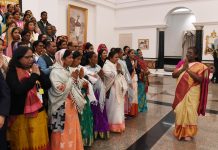






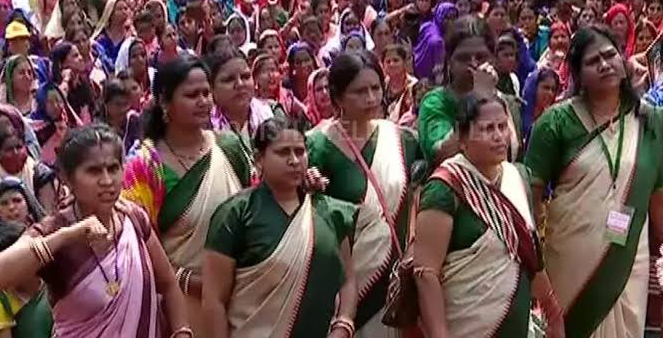
The BJD has the legacy of Mission Shakti and the organisational advantage created by years of engagement with women. The BJP has the advantage of being the incumbent government and the political capital generated by Subhadra.
For more than two decades, women have been at the heart of Odisha’s political story. What began as a programme of economic empowerment, gradually evolved into one of the most significant political and social transformations in the state. The Biju Janata Dal (BJD), during its 24 years in power, understood the political importance of women early and invested heavily in building a network of women’s self-help groups through Mission Shakti.
Now, the political landscape has changed. The BJP, which ended the BJD’s uninterrupted rule in 2024, has launched its own major women-centric initiative—Subhadra Yojana. The political contest for Odisha’s women voters has therefore entered a new phase.
The question is no longer whether women matter electorally in Odisha. They clearly do. The bigger question is: Which party can build a deeper and more enduring relationship with them before the next Assembly election.
When Mission Shakti was launched in 2001, its stated objective was women’s economic empowerment through self-help groups, credit access, livelihood activities and market linkages. Over the years, the programme developed into a vast network of women’s organisations across the state. The Odisha government’s Mission Shakti department describes women’s economic independence and the promotion of women self-help groups as core of the programme.
The political significance of this transformation was enormous. Women who had traditionally been seen primarily as beneficiaries of government welfare increasingly became participants in economic and community activities. SHGs created networks that connected women with banks, government programmes, local administration and markets.
For the BJD, this created an important political advantage. Mission Shakti became associated with the party’s larger narrative of women’s empowerment. Over time, women became one of the most important constituencies in the BJD’s electoral strategy. But the 2024 election demonstrated that this support could not be taken for granted.
Women voters did not remain permanently attached to the party that had initiated or expanded a particular programme. The BJP succeeded in making a direct appeal to women, including through the promise of Subhadra Yojana. Analysts subsequently pointed to women’s voting behaviour as one of the factors that may have contributed to the BJP’s electoral breakthrough.
The BJP’s response was not merely political rhetoric. Subhadra Yojana offered eligible women financial assistance of ₹10,000 a year, with a total entitlement of ₹50,000 over five years. The official scheme describes its objectives as strengthening women’s financial independence, household decision-making and participation in economic activities. The scheme was launched in Bhubaneswar by Prime Minister Narendra Modi in September 2024, with the first transfer reaching more than 10 lakh women.
Subhadra therefore represents something more than another welfare scheme. Politically, it is the BJP’s attempt to establish a direct relationship with a constituency that had long been associated with the BJD.
There is an important distinction between the two approaches. Mission Shakti built a collective institutional network. Subhadra provides direct household-level financial assistance. One operates substantially through women’s groups, livelihoods and community networks; the other creates a direct financial connection between the government and individual beneficiaries. The long-term political impact of these two models will be fascinating to watch. Will cash transfer beat a 24-year network? This is where the battle becomes more complicated.
A direct cash benefit can create immediate visibility. A woman receiving money directly into her bank account can clearly identify the government responsible for the payment. That creates a potentially powerful political connection.
But Mission Shakti’s political legacy cannot be measured simply by the value of financial assistance. For many women, SHGs created social networks, financial awareness, access to credit and a degree of economic independence. The programme’s loan and livelihood architecture was designed to support income-generating activities rather than merely provide consumption support. The state has also promoted affordable credit for women’s SHGs through its bank-linkage and interest-subvention programmes.
Therefore, the BJP faces an interesting challenge. Can a five-year financial assistance programme create the same depth of political identification that a 24-year-old social and economic network has created? The answer will depend partly on implementation and partly on what happens beyond the cash transfer. If Subhadra helps women start businesses, increase household income, acquire skills or gain greater financial independence, it could evolve from a welfare scheme into a political institution. If it remains primarily a periodic financial transfer, its political impact may be more dependent on the continuation and size of the benefit.
The BJD, meanwhile, faces its own dilemma. It cannot simply remind women that Mission Shakti was its creation. Political loyalty is rarely based entirely on the history of a scheme. The party must demonstrate that it still understands the changing aspirations of women. Today’s rural woman may want more than subsidised credit. She may want a profitable enterprise, a smartphone, digital banking, better roads, education for her children, employment opportunities, healthcare and a greater voice in family decisions.
The younger generation of women may have very different expectations from those who joined SHGs two decades ago. For the BJD, therefore, defending its traditional women vote will require renewal rather than nostalgia.
The BJP has an important opportunity. Subhadra gives the government a direct channel to a huge constituency. But the political challenge is to convert beneficiaries into a broader community of supporters without reducing women to recipients of government money. The BJP will have to demonstrate that its women-centric policies extend beyond Subhadra. Issues such as women’s employment, safety, entrepreneurship, education, maternal health, nutrition, property ownership, access to credit and political representation will increasingly matter
Once women become accustomed to receiving a government benefit, they may also become more demanding voters. They can ask whether the amount is sufficient, whether payments are regular, whether eligibility is fair and whether the scheme improves their lives beyond the annual transfer. In that sense, Subhadra could empower women politically in an unexpected way: beneficiaries may become more demanding citizens.
Perhaps the biggest mistake either party could make is to treat Odisha’s women as a single political constituency.
A young urban woman in Bhubaneswar may have very different priorities from a tribal woman in Kandhamal, an SHG member in Mayurbhanj, a farmer’s wife in western Odisha or a small entrepreneur in coastal Odisha. Age, income, occupation, education, geography and family circumstances all influence political choices. The next phase of women’s politics in Odisha will therefore be more fragmented and sophisticated. Women may support one party because of a welfare programme and another because of local leadership. They may appreciate a government scheme but still vote according to issues such as employment, inflation or law and order. The assumption that receiving a benefit automatically produces electoral loyalty could therefore prove misleading.
Whatever may be the case, there has been a silent contest before 2029 to woo women voters between BJP and BJD. The battle for women voters is already becoming one of the most important political contests in Odisha. The BJD has the legacy of Mission Shakti and the organisational advantage created by years of engagement with women. The BJP has the advantage of being the incumbent government and the political capital generated by Subhadra.
However, neither advantage is permanent. The BJD will have to convince women that its empowerment model remains relevant in a changing Odisha. The BJP will have to demonstrate that Subhadra is not merely an election promise fulfilled but the beginning of a larger economic and social empowerment programme.
And there is a third possibility: women may not return across-the-board to either party.
The 2029-woman voter may be more independent, more informed and more demanding than the woman voter of 2000 or even 2024.
The real battle is for trust. Ultimately, the contest between Mission Shakti and Subhadra is not simply a contest between two government schemes. It is a contest over political trust. The BJD spent 24 years building a relationship with women through a network of self-help groups, welfare initiatives and political messaging around empowerment. The BJP is now attempting to build its own relationship through direct financial assistance and a new political narrative.
The party that succeeds in convincing women that it understands not merely their immediate financial needs but also their aspirations for dignity, income, security and independence may hold the political advantage in 2029.
Odisha’s women are no longer merely a vote bank waiting to be courted. They are becoming one of the state’s most powerful political constituencies. And the battle for their trust may well decide the next chapter of Odisha politics.