


























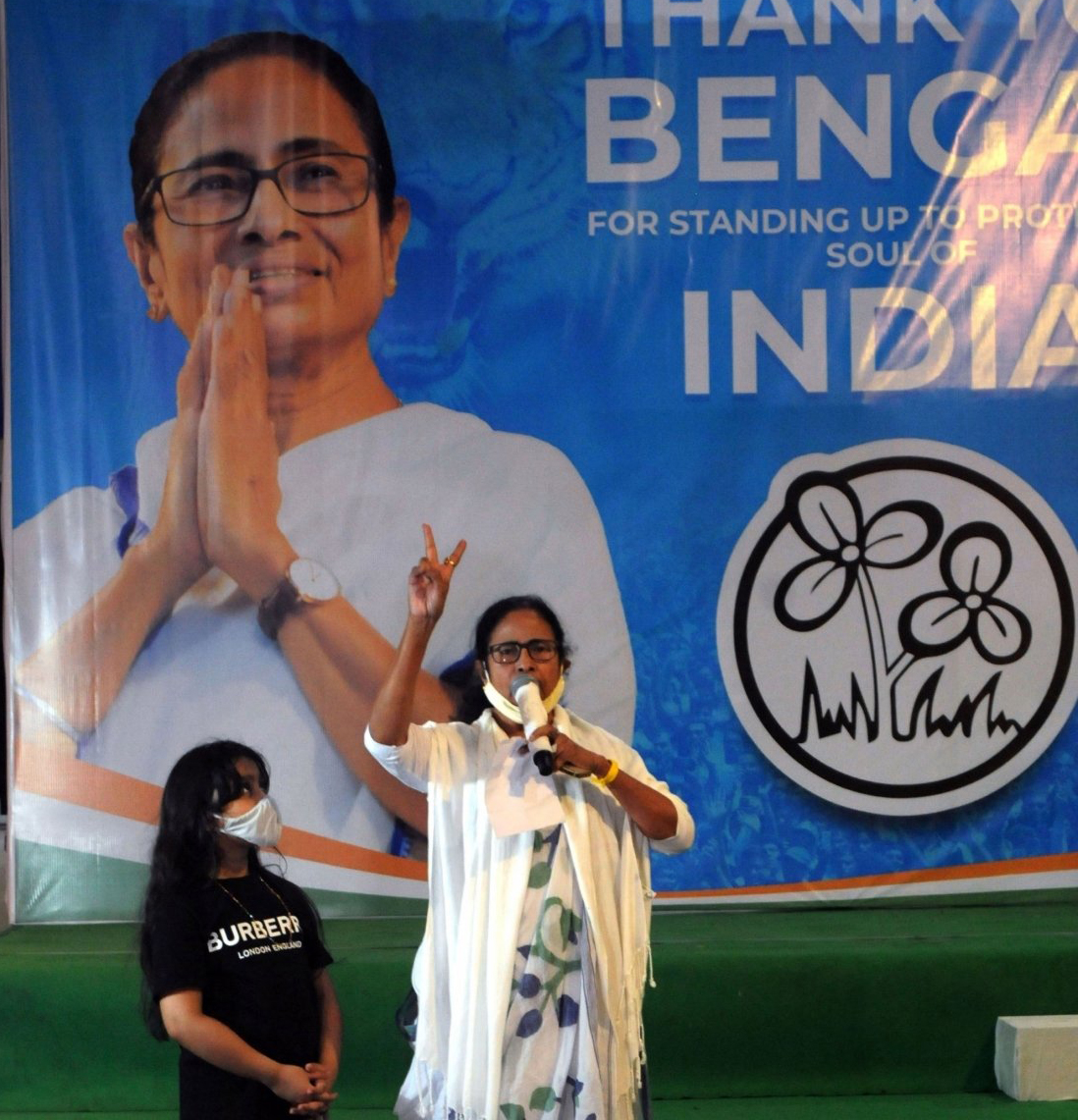
Mamata Banerjee’s journey from a lower middle-class household in Kolkata to the pinnacle of Indian politics remains one of the most dramatic political stories of modern India.
The High-profile election in West Bengal came to an end with defeat of three-time Chief Minister Mamata Banarjee and BJP taking over power for the first time in the state.
In the turbulent and emotionally charged political landscape of India, few leaders have shaped the destiny of a state as profoundly as Mamata Banerjee. Revered by millions as “Didi,” feared by political opponents for her fiery aggression, and admired for her unmatched resilience, Mamata Banerjee’s journey from a lower middle-class household in Kolkata to the pinnacle of Indian politics remains one of the most dramatic political stories of modern India.
For nearly three decades, Mamata Banerjee dominated the politics of West Bengal. She dismantled the 34-year-old Left Front rule, built a party from scratch, defeated mighty political alliances, and emerged as one of the strongest regional leaders in India. Yet politics, by its very nature, remains unpredictable and unforgiving. The hypothetical defeat of Mamata Banerjee in the 2026 Bengal Assembly election after ruling the state for over fifteen years would mark not merely an electoral setback, but the symbolic end of an era.
At 71, standing at the crossroads of triumph and decline, the question before India would be — can Mamata Banerjee rise again?
Humble Beginnings
Mamata Banerjee was born on January 5, 1955, in Kolkata, West Bengal, into a simple Bengali family. Her father, Promileswar Banerjee, was a freedom fighter and active Congress worker. His early death placed immense financial pressure on the family. Mamata’s childhood was marked not by luxury but by struggle, discipline, and determination.
Unlike many elite politicians of India, Mamata’s upbringing was deeply rooted in ordinary Bengali culture. She often spoke about helping her mother in household chores and supporting the family during difficult times. The hardships of her early life shaped her combative personality and sharpened her sensitivity toward the poor and marginalized.
From an early age, Mamata displayed unusual boldness. She was outspoken, energetic, and politically aware. Her educational journey included degrees in history, Islamic history, education, and law from institutions affiliated with the University of Calcutta. Even as a student, she was more attracted toward activism than academic glamour.
Entry into Student Politics
Mamata Banerjee’s political awakening began during her student years. She became actively associated with the student wing of the Congress party at a time when West Bengal politics was witnessing violent ideological battles between Congress and the Left parties.
The rise of communist politics in Bengal during the 1970s deeply influenced her political character. Mamata emerged as a fierce anti-Left activist, often confronting communist student organizations directly on campuses and streets. Her fearless protests and vocal approach soon made her popular among Congress workers.
Unlike traditional politicians who relied on calculated diplomacy, Mamata thrived on emotional politics. She preferred street battles over closed-door negotiations. This aggressive political style became her greatest strength throughout her career.
Giant Killer of Indian Politics
The turning point in Mamata Banerjee’s political life came in 1984. Riding on the massive sympathy wave following the assassination of Indira Gandhi, the Congress party swept the Lok Sabha elections under the leadership of Rajiv Gandhi.
In West Bengal, a young Mamata Banerjee was fielded from the prestigious Jadavpur constituency against veteran communist leader Somnath Chatterjee, one of the tallest leaders of the CPI(M). Very few expected the young firebrand to survive against such a political giant. But Mamata stunned Indian politics by defeating Somnath Chatterjee. At just 29, she became one of the youngest Members of Parliament in India. The victory transformed her overnight into a national political sensation. Her fiery speeches, relentless attacks on the Left Front government, and grassroots connect made her immensely popular among Congress workers in Bengal.
Closeness with Rajiv Gandhi
Mamata Banerjee soon became one of the trusted young leaders of Rajiv Gandhi. The then Prime Minister recognized her aggressive political instincts and mass appeal. Rajiv Gandhi’s modern outlook and Mamata’s youthful energy created a strong political understanding between the two. Mamata was frequently seen as part of the emerging younger generation within Congress leadership during the late 1980s.However, the Congress party in West Bengal remained organizationally weak and divided. Mamata increasingly grew frustrated with what she considered the passive attitude of the state Congress leadership against the Left Front. Even then, her national stature continued to rise.
The Street Fighter
Throughout the 1990s, Mamata Banerjee established herself as perhaps the most vocal anti-communist leader in West Bengal. Her politics was emotional, confrontational, and highly theatrical. She organized protests, rallies, hunger strikes, and marches against the Left government led by Jyoti Basu. Several incidents during this period enhanced her image as a fearless fighter.
One such moment came in 1990 when she was physically attacked during a political protest at Hazra Crossing in Kolkata. The image of an injured Mamata fighting back became symbolic of her resistance politics. For supporters, she represented courage. For critics, she represented political chaos. But nobody could ignore her.
Union Minister and National Recognition
Mamata Banerjee’s aggressive political style earned her significant roles at the national level. She served as Union Minister of State for Human Resource Development, Youth Affairs, Women and Child Development, and later handled important portfolios like Railways.
As Railway Minister, she attempted to connect emotionally with ordinary people by introducing several passenger-friendly schemes and projects focused on eastern India. Her railway budgets often reflected populist politics mixed with regional aspirations. Despite her ministerial success, Mamata felt increasingly isolated within Congress. She accused the party leadership in Bengal of compromising with the Left Front and failing to fight sincerely against communist dominance.
This ideological and organizational conflict eventually pushed her toward a historic political decision.
Birth of the Trinamool Congress
In 1998, Mamata Banerjee broke away from Congress and founded the All India Trinamool Congress, popularly known as TMC. Many dismissed the new party as a temporary rebellion. But Mamata’s personal popularity quickly transformed the Trinamool Congress into Bengal’s principal opposition force.
The party’s symbol — grass and flowers — was carefully chosen to reflect rural identity and grassroots politics. Mamata projected herself as the daughter of Bengal fighting against communist oppression and Congress weakness alike. The rise of TMC fundamentally changed Bengal politics.
Alliance with NDA
In one of the most surprising political developments of the late 1990s, Mamata Banerjee aligned with the Bharatiya Janata Party-led NDA government headed by Atal Bihari Vajpayee. For a secular Bengali leader, the alliance with BJP raised many eyebrows. However, Mamata defended the decision as a strategic necessity to defeat the Left Front in Bengal.
She served as Railway Minister in the NDA government and maintained cordial relations with Vajpayee. Yet ideological discomfort and political compulsions frequently created tensions within the alliance. Eventually, Mamata distanced herself from NDA politics and repositioned herself as a secular regional force.
Singur, Nandigram and the Fall of the Left
The defining chapter of Mamata Banerjee’s career came during the Singur and Nandigram agitations. The Left Front government led by Buddhadeb Bhattacharjee attempted aggressive industrialization by acquiring agricultural land. Mamata Banerjee seized the opportunity to lead massive protests against land acquisition. In Singur, she opposed the Tata Nano project, accusing the government of forcibly taking farmers’ land. In Nandigram, violent clashes between villagers and police created widespread anger against the Left government.
Mamata transformed these movements into emotional battles for farmers’ dignity and Bengali identity. Her hunger strikes and relentless campaigning generated enormous public sympathy. The communist fortress that had ruled Bengal since 1977 began collapsing.
Historic Victory in 2011
In 2011, Mamata Banerjee achieved what once appeared impossible. The Trinamool Congress defeated the Left Front decisively, ending 34 years of communist rule in West Bengal — one of the longest democratically elected communist governments in the world.
Mamata Banerjee became the first woman Chief Minister of West Bengal. For millions of Bengalis, her victory symbolized revolution. She was celebrated not merely as a politician but as a liberator who ended decades of political stagnation. Her simple white saree, rubber slippers, and emotional speeches strengthened her image as a leader of the common people.
Consolidation of Power
Between 2011 and 2026, Mamata Banerjee remained the central axis of Bengal politics. Despite corruption allegations, internal party controversies, and rising political violence, she repeatedly outmanoeuvred opponents through welfare politics, minority support, and powerful grassroots organization. Schemes focused on women, students, and rural families expanded her popularity. Her cultural projection of Bengali identity also helped resist BJP’s growing influence.
However, over time, criticism against her government intensified. Allegations of corruption, political favoritism, syndicate culture, and administrative centralization increasingly damaged the image of TMC. The rise of BJP in Bengal gradually transformed state politics into an intense ideological battlefield.
The Great Debacle
The hypothetical 2026 defeat of Mamata Banerjee would represent one of the biggest political upsets in recent Indian history. After four consecutive terms, anti-incumbency, organizational fatigue, corruption allegations, and aggressive BJP expansion finally succeeded in ending her dominance.
Under the leadership of Narendra Modi and Amit Shah, BJP allegedly converted Bengal into its most ambitious political battleground. The party’s disciplined cadre network and sustained campaign reportedly broke through Mamata’s once impregnable support base.
The appointment of Suvendu Adhikari as Chief Minister would carry enormous symbolic significance, especially because he was once Mamata’s close confidant before joining BJP. Mamata Banerjee’s refusal to initially accept defeat and her allegations against the Election Commission would further deepen political tensions.
For supporters, it would reflect resistance. For critics, denial.
Can Mamata Rise Again?
History shows that Mamata Banerjee has never been an ordinary politician. She has survived political isolation, physical attacks, organizational collapse, and repeated predictions of political death.
Her greatest strength has always been her ability to emotionally connect with ordinary people. Even in defeat, she would remain one of India’s most recognizable political personalities. The number of followers of Mamata Banerjee in social media, instead of witnessing a fall, has moved upward after her defeat. Her followers in social media, which was 5.8 million, before her defeat has gone up to as high as 6.1 million now.
Yet age, changing political realities, and BJP’s organizational rise present unprecedented challenges. Bengal politics has evolved dramatically from the era when Mamata alone symbolized opposition. Whether she stages another comeback or gradually fades from active politics, her impact on West Bengal is undeniable. She redefined regional politics, destroyed communist supremacy, and proved that a single determined leader could alter the political destiny of an entire state.
The story of Mamata Banerjee is therefore not merely about victory or defeat. It is the story of ambition, rebellion, resilience, emotion, and power. It is the story of a woman who rose from the narrow lanes of Kolkata to dominate one of India’s most politically conscious states for decades. And perhaps, even after the fall, history may still remember her simply as — Didi.