





















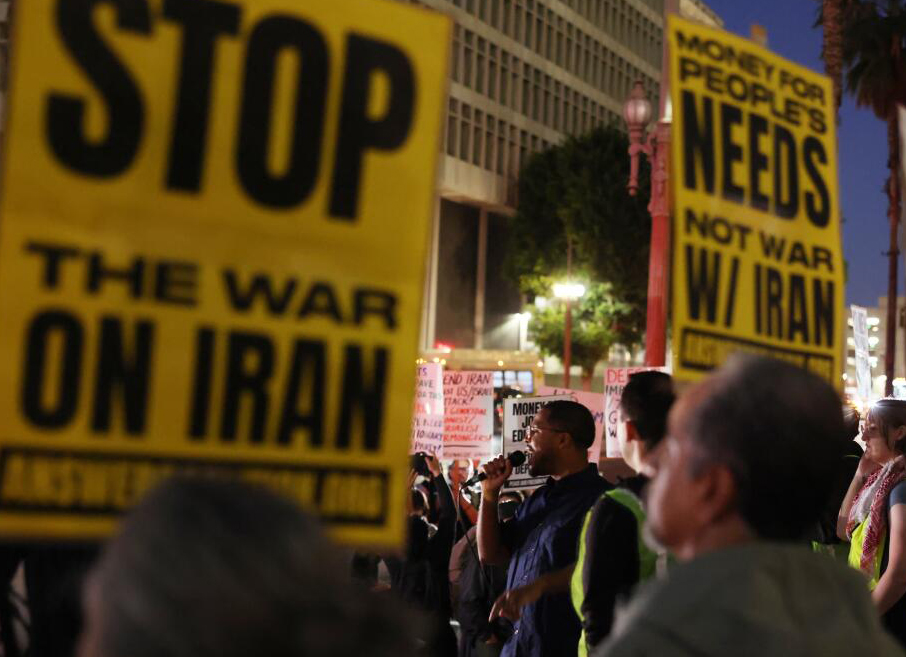
The “No Kings” protests are demonstrated in all the US cities and also in Europe. These protests are a series of widespread, non-violent demonstrations, opposing the second administration of U.S. President Donald Trump. These protests are organized by coalition groups to protest perceived authoritarianism, “king-like” executive power, the 2026 Iran war, and immigration policies of Trump Administration. All want the end of the war.
Since the war began on February 28, Iran has largely ignored Trump’s threats, responding to escalation with counter-escalation. When the U.S. bombed Kharg Island, Iran struck American bases in the region. When Israel targeted South Pars, Iran hit energy facilities across Qatar, the UAE, Saudi Arabia, Kuwait and Israel. After the Natanz nuclear facility was struck, Tehran targeted Dimona, the Israeli town hosting its nuclear facilities. When Trump threatened strikes on Iran’s power plants, Tehran warned of attacks on Gulf and Israeli energy assets and U.S. financial interests, forcing him to make a U-turn.
Donald Trump’s decision to postpone attacks on Iran’s power plants, 36 hours after issuing a 48-hour ultimatum to Tehran to reopen the Strait of Hormuz, is the clearest sign yet that the war is not going according to his plan. Over the past week, Trump has declared victory, claiming that U.S. and Israeli strikes had destroyed Iran’s defence capabilities. Yet, Iran continues to launch missiles at Persian Gulf countries and Israel, while maintaining control over the Strait of Hormuz, which prevents Trump from extricating himself from a conflict whose economic costs are mounting globally.
Before the war began, the U.S. and Israel had set ambitious objectives: force Tehran to shut down its nuclear programme and ship out the highly enriched uranium, cut off Iran’s support for non-state militias in West Asia and dismantle its missile capabilities. A month later, one of Trump’s key priorities is to open the Strait of Hormuz, which was closed only after the war broke out. He does not have easy options to do so — he has to either talk to Tehran and make a deal or authorise a ground operation. Reports suggest the U.S. has already despatched thousands of marines.
Yet, Trump’s U-turn on strikes on power plants indicates that he may be seriously weighing talks. Iran has dismissed Trump’s claims that negotiations are underway. But President Masoud Pezeshkian has outlined conditions for ending the war: guarantees against future aggression; reparations for infrastructure damage; and recognition of Iran’s legitimate rights. Trump, whose administration has already eased some sanctions on Iran’s oil, could be looking for a deal, and Tehran could reciprocate if common ground is found. But for any diplomatic effort to progress, Trump must first rein in his ally Israel, which continues to pound Iran and Lebanon like an unhinged bully. The military path that he has embraced is showing clear limits. The least damaging way out for Trump is to strike a deal with Iran and get out of this war.
Trump, on March 21, had issued a 48-hour ultimatum to Iran to reopen the Strait of Hormuz or face U.S. attacks on its power plants. Iran responded saying it would hit back at the energy infrastructure and American economic interests across the Persian Gulf. On March 23, Trump took an abrupt U-turn, saying he was in talks with Tehran and postponed strikes by five days. His new deadline was set to expire on Friday, March 27.
“I am pausing the period of Energy Plant destruction by 10 Days to Monday, April 6, 2026, at 8 P.M., Eastern Time. Talks are ongoing and, despite erroneous statements to the contrary by the Fake News Media, and others, they are going very well,” Trump wrote in a social media post on March, 26 night.
Iran has denied holding talks with the U.S. Pakistan’s Foreign Minister Ishaq Dar said on March, 25 that Islamabad had relayed a 15-point peace plan from Washington to Tehran. Iran’s state media reported that Tehran has dismissed the U.S. plan and made counter-proposals.
While conflicting messages are emerging about talks, Israel and Iran continued to trade fire. Israel’s Defence Minister Israel Katz said that Tel Aviv would ramp up air strikes on Iran in the coming days. The Israeli military also confirmed that it struck a heavy water reactor and a uranium processing plant in central Iran.
Iran’s Islamic Revolutionary Guard Corps (IRGC) said in a statement that they targeted storage tanks and the oil depot in Ashdod, Israel, and a U.S. military information exchange centre in the region. The IRGC also struck American military bases at Al-Dhafra in UAE, along with maintenance and storage hangars at Ali Al-Salem Air Base in Kuwait.
The ongoing US-Israel conflict involving Iran has generated greenhouse gas emissions equivalent to those of 84 of the world’s lowest-emitting countries combined within just two weeks. The analysis, estimated total emissions of about 5.05 million tonnes of CO₂ in the first 14 days of the conflict, driven by large-scale destruction of infrastructure, fuel consumption in military operations and fires at oil facilities.
United Nations (UN) Secretary-General Antonio Guterres has warned that the ongoing conflict is disproportionately affecting the poorest and the most vulnerable populations, calling for an immediate end to the war and a renewed push for diplomacy. In a post on social media, Guterres said the humanitarian consequences of the conflict are being borne by civilians who have no role in the conflict. He added that shock waves of the conflict in West Asia are falling hardest on those who bear no responsibility, the poorest & the most vulnerable.
The U.S.-Israeli conflict with Iran has severely disrupted the global economy, energy, and food security, primarily due to the near-closure of the Strait of Hormuz. With 27% of oil exports and 20%-30% of global fertilizer trade passing through this chokepoint, prices for fuel and nitrogen-based fertilizer have skyrocketed, causing widespread economic shock.
People do not want war. The madness of Trump to ‘Make America Great Again’ may end in destruction. Our civilisation will be at risk. Therefore, we must end the war.