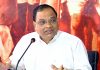












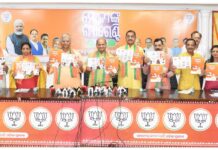













Chief minister Mohan Charan Majhi’s politics has always revolved around development but he has also proved himself to be an excellent organiser and strategist. His acumen as a political strategist was in evidence during the Nuapada assembly by-poll with BJP registering a thumping victory. He is expected to do something similar to ensure that BJP wins at least three out of the four Rajya Sabha seats that would go to polls soon.
The Bharatiya Janata Party’s (BJP) victory in the Nuapada assembly by-poll last year highlighted the leadership qualities of chief minister Mohan Charan Majhi. His success in persuading former Biju Janata Dal (BJD) MLA Rajendra Dholakia’s son Jay Dholakia to contest the election on BJP’s ticket was a master stroke that proved decisive, tilting the balance in favour of the saffron party. Majhi also proved himself to be an excellent organiser who managed the entire campaign nicely. In a way it was a personal victory for Majhi. Now the chief minister is going to face another test with four Rajya Sabha seats in Odisha going to fall vacant. While BJP is certain to bag two seats easily on its own strength, one is almost certain to go to the Naveen Patnaik-led BJD. It is the fourth seat that presents a real challenge to the ruling party. Though BJP leaders appear confident about winning this seat the algorithm needs to be understood and explained. Once again Majhi is supposed to play a key role in turning things in favour of his party as far as the fourth seat is concerned. Out of the four seats which will go to polls, the BJP has clear numbers to win two while the BJD should win one seat without breaking a sweat. The BJP has 79 MLAs in the state Assembly and the support of three Independents, making its effective strength 82. The BJD, on the other hand, has 50 MLAs including the two suspended legislators. Congress and CPM have 14 and one MLAs respectively in a House of 147 members. The BJP with the strength of 82 members in the Assembly can comfortably win two seats and have 22 surplus votes. Similarly, BJD will be left with 20 surplus votes after the victory of its candidates after the first preference votes. Hence, it is the fourth RS seat which would be keenly watched. But sources in the BJP say that the party is almost certain to field a third candidate. On the face of it if BJD and Congress join forces, the Opposition can snatch the fourth seat but as of now there is no definite indication from BJD that it would field a second candidate. On the other hand, there is also intense speculation about the possibility of Congress fielding a candidate which could spoil the BJD’s party and work to the advantage of the BJP. There is also intense speculation about the possibility of BJD allowing its MLAs to exercise their conscience in the case of the fourth seat. That might set the stage for horse trading and also dent the image of the party and its top leadership. At the same time this would make things easy for the BJP. The Rajya Sabha contest, too, is going to test Majhi’s mettle. The best thing about the chief minister is that his politics is deeply rooted in development which has been his “mantra” right from the day he assumed office. He continues to drive Odisha’s development dexterously. Recently he unveiled an economic plan for Bhubaneswar-Cuttack-Puri-Paradip Economic Region which, he believes, would be the state’s laboratory for development and prosperity.
Launching BCPPER, the chief minister said that this region will be developed as a centre of economic growth of the state. “The BCPPER will play an important role in the economic growth of the state as well as the country,” Majhi said while describing the proposed region as a new star in the growth sky of India, the chief minister said that all the cities of this region have their own potentialities and uniqueness.
While Bhubaneswar is developing in the field of technology, Cuttack is the business centre of the state. Puri is known for its cultural heritage and tourism potential and Paradip has emerged as a port-based economy. “Now our plan is that this region will be connected with modern infrastructure, and various projects will be undertaken in each city. More than 80 projects have been planned, such as metal downstream, biotech, textiles, chemicals, tourism, education and IT,” the chief minister said. Noting that NITI Aayog has prepared the economic plan for BCPPER, Majhi said more than 30 policy initiatives will be taken up to bring development and prosperity to the entire region. The chief minister said that the Union government in its 2026-27 annual budget has earmarked ₹5,000 for each City Economic Region in the country.
“The NITI Aayog has already approved our plan and included the BCPPER in the CER initiative,” Majhi said, lauding the impact of “double engine” in Odisha. The CM noted that at present, the economy of this region is 19 per cent of the entire Odisha economy. “The target is to make the economy of the region 500 billion dollars by 2047,” he said, adding that the central government and NITI Aayog will develop this region as a centre of economic transformation. Odisha has also taken another decisive step towards job-led industrial growth with the approval of 23 industrial investment proposals worth ₹4,111.80 crore, expected to generate 9,924 employment opportunities, under the State’s Single Window clearance mechanism.
The approvals were accorded at the 144th meeting of the State Level Single Window Clearance Authority (SLSWCA), chaired by Chief Secretary Anu Garg, reflecting the state government’s push to translate investment intent into on-ground projects. The clearances mark a significant milestone in Odisha’s industrial expansion drive under the leadership of Chief Minister Mohan Charan Majhi, with a sharp focus on employment creation and diversified manufacturing. The approved proposals span a broad spectrum of sectors including mechanical and electrical capital goods, apparel and textiles, aerospace and defence manufacturing, shipbuilding and ship repair, pharmaceuticals, chemicals, refractories, aluminium downstream industries, mineral beneficiation, metal downstream, plastics, glass manufacturing, logistics and warehousing, infrastructure, and tourism and hospitality. The wide sectoral spread highlights Odisha’s evolving, future-ready industrial ecosystem that balances traditional strengths with emerging industries. Odisha, thus, continues to march forward under Majhi’s leadership while BJP as a party keeps going from strength to strength.