






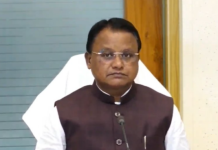


















The New Year has begun on a positive note for the state government with chief minister Mohan Charan Majhi ensuring all-round development of the state. Odisha is witnessing growth not only on the industrial front but also in women and youth empowerment and in making farmers empowered and richer.
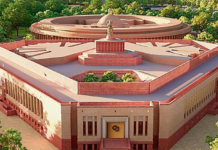
The New Year is about a fortnight old now but it marks a new beginning for the Mohan Majhi government with focus on industrialization, youth and women empowerment and the welfare of farmers. The developmental momentum generated during 2025 continued to push growth under the leadership of Majhi. The bygone year saw Odisha getting firmly set on the path of all-round growth with major milestones being achieved in the field of industrialization and BJP winning its first by-election under the leadership of chief minister Mohan Majhi. There was also commendable progress in Odisha’s fight against Maoists with security forces neutralising six rebels, including CPI(Maoist) central committee member Ganesh Uike, who carried a bounty of Rs 1.1 crore on his head. The year also saw around 22 Maoists surrender before police under the revised Surrender and Rehabilitation Policy, which offers incentives of up to Rs 1.20 crore depending on rank. There were major achievements on the industrial front including the sanction of two semiconductor units and projects worth Rs 4.38 lakh crore for the state. Noting that the industrial sector is passing through transition from mineral based to manufacturing hub the chief minister said the state signed two MoUs worth Rs 4,000 crore for semiconductor units. Whenever there were problems the government took immediate steps to solve them and also took initiative to ensure that similar problems did not occur in future. One of the most important initiatives was to ensure the safety and security of girls reading in schools and colleges. Policing was strengthened to prevent cases of assault on women. While Subhadra Yojana made women financially empowered the above-mentioned initiatives guaranteed the safety of women, both working and non-working. Politically, the year saw organisational changes across major parties. BJP stalwart Manmohan Samal was reappointed as state unit president, while Naveen Patnaik continued as BJD president for the ninth term. The Pradesh Congress Committee got a new president in Bhakta Charan Das. The year also saw the Nuapada assembly by poll following the death of BJD MLA Rajendra Dholakia. His son Jay Dholakia contested on a BJP ticket and won with a huge margin. IN another momentous development President Droupadi Murmu addressed the Odisha Assembly in November. The momentum of development generated during the past year has continued in 2026 with chief minister Mohan Charan Majhi recently laying the foundation stone of the new state Assembly building integrated with a state-of-the-art Lok Seva Bhawan complex in the capital city, which would be constructed at a cost of Rs 3,623 crore. Announcing the start of work on ambitious projects at a state-level function Majhi said the new Assembly building will be constructed to meet the state’s future legislative requirements. It will have a capacity to seat 300 members. “At present, the strength of the Odisha Legislative Assembly is 147. After the next delimitation exercise, the number is likely to increase to around 200. Therefore, we are constructing the new Assembly building keeping in mind the needs of the next 50 to 100 years,” said Majhi. He added that the expanded capacity is aimed at ensuring that the state’s governance infrastructure remains future-ready and capable of accommodating any rise in the number of elected representatives following population-based delimitation. Works minister Prithiviraj Harichandan said that an integrated secretariat (Lok Seva Bhawan) complex will streamline administrative functions under a common campus and make governance more effective. The secretariat, presently, remains scattered and unplanned. He said the development of the complex will be taken up in three phases. Phase-I will witness new secretariat-cum-mantralaya (3 basements+ ground+11 floors), new office building near Powerhouse Square (3B+G+11), Biparjaya Parichalana Bhawan (3B+G+11), service building (B+G+1) and allied infrastructure at an estimated cost of Rs 3,623 crore. All the 12-storey buildings will have provision of 3-level underground parking. It has been planned to construct the new Lok Sabha Bhawan building over an area of 14.5 acres beside Kharvel Bhawan and OPEPA campus. This will house the offices of ministers and secretaries for 45 departments with dedicated floors for the chief minister, chief secretary and development commissioner. It has also been proposed to construct 12-storey Biparjaya Parichalana Bhawan (office complex for OSDMA) near Rajiv Bhawan. In order to relocate the offices which are being demolished under phase-I, an office building of 3B+G+11 will be constructed near the Powerhouse Square in front of Nirman Soudha over an area of 1.71 acres. The plan is part of the full development of 71.13 acres as new Secretariat campus which would be developed in the second phase. In the phase-II, the new Assembly building will be constructed with a basement, a ground floor and first floor along with an annexe building (3B+G+11), two service buildings (B+G+1) and a new office building beside Nirman Soudha campus (3B+G+11) along with allied infrastructure will be done at an estimated cost of Rs 1,470.44 crore. The third phase will see future development comprising an annexe building for the Assembly (B+G+1) and allied infrastructure at an estimated cost of Rs 387.94 crore. The government is also taking care of rural infrastructure projects with project selection being simpler under the government’s flagship ‘Bikashita Gaon, Bikashita Odisha’ (BGBO) initiative, with thrust on creation of durable community assets. Under the revised guidelines, the government has substituted the existing project selection process with a more participatory, gram sabha-driven mechanism. Each gram sabha will now prepare a need-based list of projects in line with the financial allocation for the financial year concerned. The nodal officer attending these meetings will immediately forward the project list to the district collector, removing layers of delay at the block level. Collectors will also invite project proposals annually from PRI members, elected representatives and civil society organisations. Notices seeking such proposals will be displayed at the collectorate, zilla parishad, block and gram panchayat offices, and uploaded on the district website. Commissioner-cum-secretary of PR&DW department, Girish SN said all project proposals from the panchayats must reach the collectors within seven days of publication of the notice. The government has also restructured the approval mechanism. A district-level committee led by the collector cum- chief executive officer will be constituted to scrutinise all proposals received from gram sabhas and other stakeholders, assess their admissibility and technical feasibility. In order to address concerns over quality and sustainability of assets, the government has introduced a mandatory defect liability period (DLP) of three years for all projects with an estimated cost exceeding `10 lakh. The executing agency will be solely responsible for upkeep and maintenance during the DLP, which will begin from the date of completion and handing over of the project. The momentum of development, thus continues and the government has ensured that the state witnesses progress on every front.